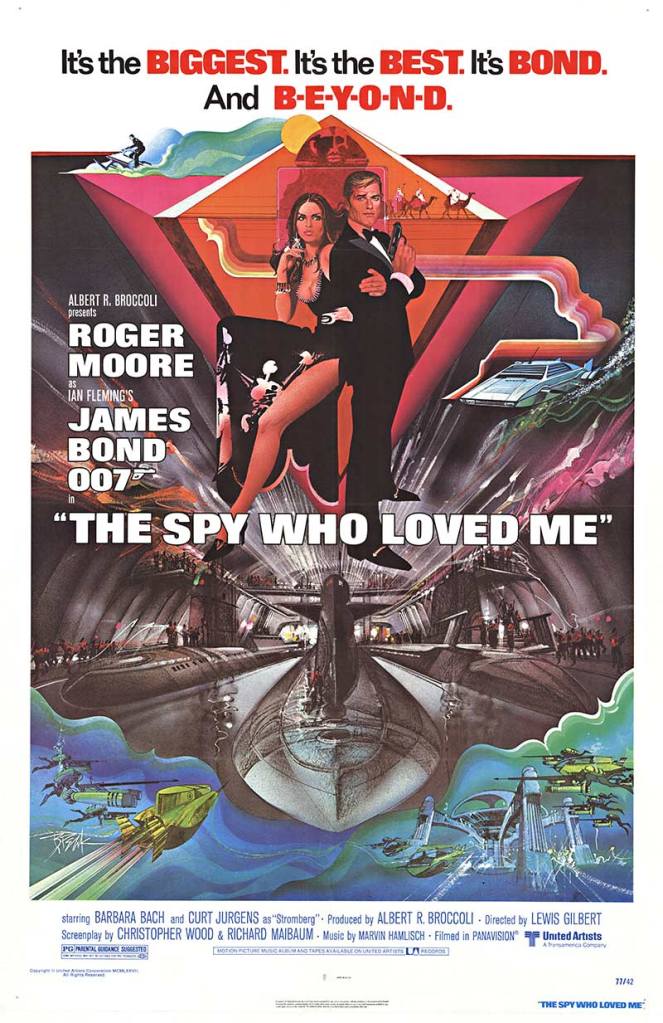
In my essay on Live and Let Die, I said that the 1970s were not the best decade for Bond films. But you can’t go a whole decade without having one really great 007 adventure, and even the 1970s had one. The Spy who Loved Me is probably the most well-regarded of the Roger Moore films within the ranks of the series fandom. It strikes the perfect balance between grounded action and fanciful whimsy. It may not be everyone’s favorite, but I do think it takes the best elements of Moore’s tenure and puts them together in a most enjoyable way.
And it’s a good thing it did, because the years it was made wwere a bit of a precarious time for the Bond series. Moore had been accepted by the audience as Bond but his sophomore outing, The Man with the Golden Gun, had been a bit of a disappointment in terms of critical reception and box-office earnings. Also, this follow-up was the first film that producer Albert Broccoli was making without the help of his partner Harry Saltzman, who had left the series a few years prior. So there was a lot riding on this film.
The pre-title sequence is one of the most narratively ambitious of the series. There’s a lot being set up here. First, we see a British submarine get hijacked somehow. Then we’re taken to Moscow where we see the head of the KGB discuss the disappearance of a Soviet nuclear submarine not unlike the British one. He decides to put his best agent, code-named XXX, on the case.
(I’ll point out that General Gogol, the head of the KGB, is played by actor Walter Gotell. Gotell had previously appeared in From Russia With Love where he played Morzeny, the head of S.P.E.C.T.R.E. island, who pursues Bond in the Ionian Sea and gets burnt to death. This new role would be much more substantial as he would appear in all five subsequent films in the series.)
The scene shifts to a Soviet recreation facility where a handsome man has just finished making love to a beautiful woman. He discusses their getting together again after he completes his latest mission. Then a music box, playing the theme from Doctor Zhivago, summons agent XXX to KGB headquarters. The man gets out of bed and it’s the woman who answers the music box, because she’s actually the Soviets’ best agent, not her lover. A nice bait-and-switch by the filmmakers there.
The scene shifts yet again to M’s office where he asks Moneypenny where 007 is. She informs him that he’s on assignment in the Austrian Alps. We cut to Bond making love to a beautiful blonde before a message coming out of his watch informs him that he’s to return to HQ immediately. He puts on a ski suit and a large backpack before skiing away, at which point the blonde informs a nearby team of assassins that he’s left the cabin. We see that the squad is led by the Russian who was in bed with XXX. A ski chase ensues, which isn’t that bad but really doesn’t compare to the ones in On Her Majesty’s Secret Service, I’m sorry to say. During the chase though, Bond uses his ski pole, which is also a rifle, to shoot one of his pursuers, who happens to be the man XXX had been in bed with. He then skis off a cliff and free-falls for a solid twenty seconds before opening a parachute that looks like the Union Jack. It is widely considered the most impressive stunt out of any James Bond film, and I’m not one to disagree with that assessment. Cue the opening credits.
The song playing over the opening credits is Carly Simon’s Nobody Does It Better. It’s a decent enough song, but if you’re a James Bond fan, you better get used to hearing it. Anytime you watch a documentary about the series or a retrospective, you’re pretty much guaranteed to hear it again. Because of its title, it gets played in a lot of these retrospectives.
Once the title is over, XXX (aka Major Anya Amasova), Is briefed on her mission and informed that her lover, Sergei Barkov, is dead after having tangled with a British agent in Austria.. She declares that she would very much like to meet the agent responsible. This, of course, is 007 who we see reporting to M and getting his own briefing about the missing nuclear submarine (neither agecy knows about how their rivals also lost a nuclear sub yet). He reveals that an unknown party is trying to sell a submarine tracking device that could have been involved in the missing submarine’s disappearance.
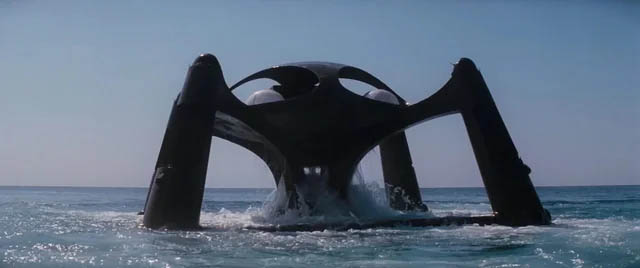
Although we don’t know who’s selling this device just yet, we are introduced to the two scientists who developed it. They are in the employ of the film’s villain, Karl Stromberg. He operates out of a submersible base in the Mediterranean, and I think it’s the most interesting looking-base out of any in the series. Sure, when you look at it, you can’t help but notice that the water around it doesn’t behave like it should, because whenever they photograph a miniature in water, the water doesn’t look like it would if this was a fullisize construct. But otherwise, it’s really a nifty base.
Stromberg informs the scientists that somebody leaked their invention’s schematics to a third party and then dismisses his secretary from the room they’re all in. When she steps into the elevator, the bottom falls out and she’s dropped into a pool with a hungry tiger shark. Stromberg knows she’s the one who betrayed him, so she has to pay the ultimate price. The scientists then board a helicopter which is blown up, and the villain dispatches his two henchmen, the brutish Sandor and the seven-foot-tall Jaws, to retrieve the microfilm of the device’s schematics.
Bond travels to Egypt where a college friend of his, who’s become a shiek, gives him a little background information and invites him to spend the night in the company of some lovely ladies. The next day, he is in Cairo where he attempts to contact the seller’s agent, Aziz Fekkesh. He visits Fekkesh’s house where a beautiful woman tries to delay him long enough for Sandor to shoot him. But the assassin hits the woman instead (or maybe Bond deliberately used her as a human shield. It’s a little unclear, to be honest). When Sandor tries to flee, 007 fights him on the building’s roof. Their fight leads them to the edge of the building where Sandor teeters precariously. Holding on to Bond’s tie, he reveals that Fekkesh will be at the pyramids this evening. Bond slaps his hand away and the goon falls to his death.
That night at a light show near the pyramids, our hero notices Fekkesh in the company of the beautiful Agent XXX. The businessmen spots Jaws observing him as well and tries to flee, but he gets cornered by the giant and killed by the henchman’s metal teeth. Before Bond can capture him, Jaws vanishes using the show’s shifting lights to cover his escape. Instead, the British spy fights a couple of thugs employed by Major Amasova and, after quickly dispatching the pair, wishes her a nice evening.
The two spies meet at the nightclub of Max Kalba, the man who employed Fekkesh and the holder of the microfilm with the tracking system schematics both agents are after. What’s notable is that, in the scene before they go to both sit at Kalba’s table, the two characters show that they know each other by reputation and the Russian mentions that Bond had been married to a wife who died. It is the first in-continuity reference to Tracy from On Her Majesty’s Secret Service since the end of that film.
Before the two spies can make offers to purchase the microfilm from Kalba, he goes to answer a telephone call only to be murdered by Jaws. Bond finds his body and realizes the assassin took the microfilm, so he ducks into the small van Jaws is using. He’s quickly joined by XXX and the two bicker, unaware that the henchman is aware of their presence and can hear their conversation. The brute drives to some isolated Egyptian ruins where he attempts to kill the agents. But they fight him off and gain possession of the microfilm. Amasova tries to escape with it but Bond has the van’s keys and they drive away, but not before Jaws does a pretty good job of tearing the vehicle apart. They manage to drive it away but it soon breaks down and they’re forced to gain passage back to Cairo on a riverboat. (There’s a quick use of the theme to Lawrence of Arabia as they reach the Nile, so somebody in the production was a real Maurice Jarre fan.) They cuddle up to each other (to conserve body heat, she insists), and then she knocks Bond out with a gas-spewing cigarette.
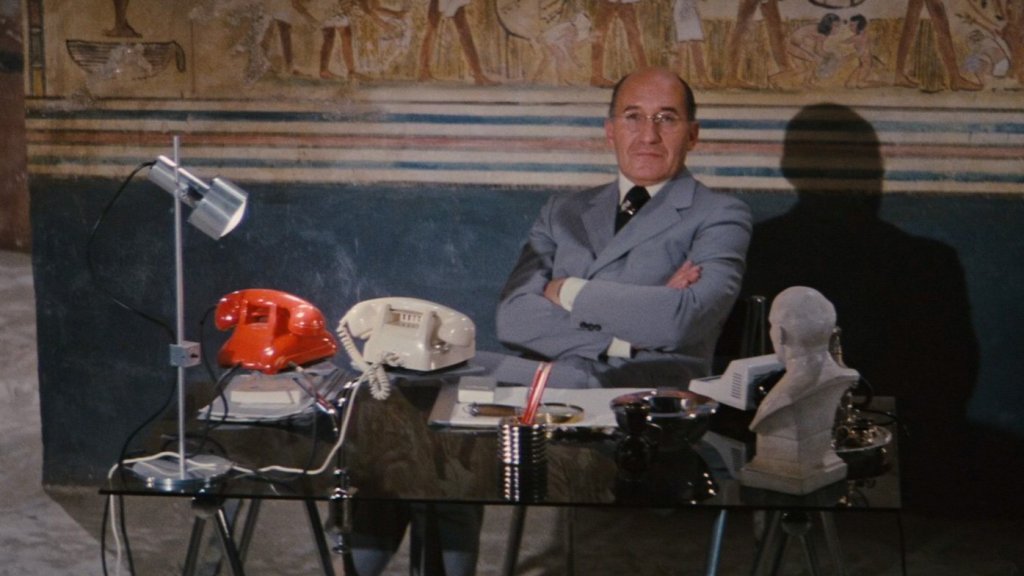
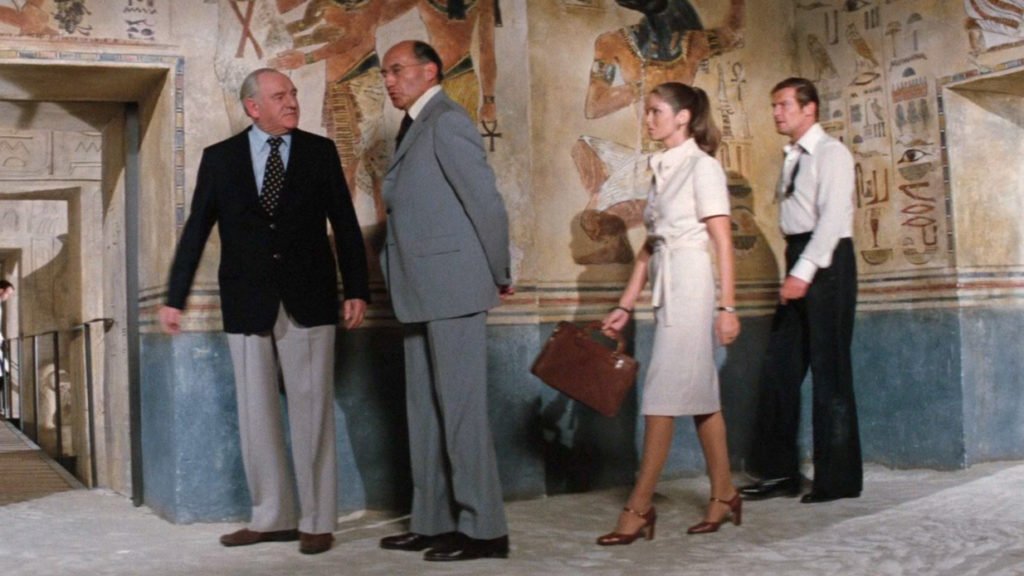
The next morning, 007 wakes up to find XXX gone along with the microfilm. With no leads left to follow, he makes his way to a secret HQ within a (presuminly) different set of ruins with Moneypenny inside. Instead of M, however, he finds General Gogol waiting for him in the makeshift office, though the British functionary soon appears to explain that the English and Soviet governments have agreed to work together on this case. Major Amasova joins the trio and while they make their way to a another room to examine the microfilm, Gogol refers to M as “Miles”, the first and only time the character’s first name is ever used in the series.
An examination of the technical schematics shows that most of the valuable information has been redacted, but Bond notices a small logo in the background of the schematics. Amasova identifies it as being the symbol of Karl Stromberg’s company. M and Gogol dispatch the two agents to investigate the mysterious industrialist at his laboratory/base off the coast of Sardinia.
Aboard a train on their way to their destination, the rival operatives finally bury the hatchet and seem more inclined to work together. After they retire to their adjoining rooms, Amasova discovers Jaws hidden in her closet and tries to fight him off. Her screams of distress alert Bond who tries to fight the giant brute as well. Neither agent has much success until 007 uses a broken lamp to electrocute Jaws’ metal teeth. This leaves the henchman off-balance long enough for Bond to kick him through the window off the speeding train. While this exact same fate was enough to spell the end of Tee-Hee in Live and Let Die, we see that Jaws simply gets up and brushes himself off as the train speeds away. Takes a lot more to kill this guy, it seems. As for Bond and Amasova, they finally give in to their long-simmering attraction to one another.
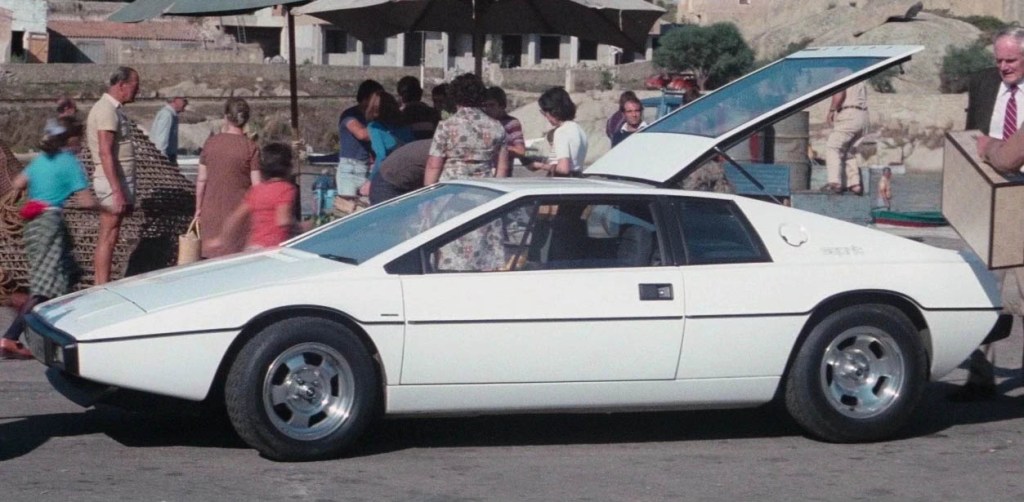
In Sardinia, the two spies meet Q who gives them a Lotus Esprit S1 sports car to drive around in. XXX refers to Q as “Major Boothroyd” when greeting him, wich finally settles the issue as to whether or not the armorer in Dr. No and Q are the same character.
Bond and Amasova pose as a marine biologist and his wife to get a meeting with Stromberg at Atlantis, his isolated base in the sea. They are taken there by the beautiful Naomi, Stromberg’s new secretary/assistant.
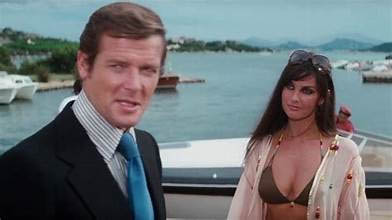
The British spy meets the industrialist but their conversation doesn’t advance the plot much. The Soviet agent, meanwhile, examines the model of Stromberg’s supertanker, the Liparus. After they both leave Atlantis, Jaws silently confirms to his employer who 007 and XXX really are and the villain orders him to kill them.
Back in Sardenia. Bond and Amasova are driving along the road when a motorcyclist pursues them. He uses his sidecar, which is actually a missile, to try to blow them up, but ends up blowing up a mattress truck instead. Now covered in feathers, he drives off a cliff. Then Jaws and some other goons in a car pursue our heroes, shooting at them with pistols. 007 uses a liquid cement shooter to obscure the front window of their car which likewise drives off a cliff. It lands in a house at the bottom and promptly blows up, though Jaws walks out and, once again, brushes himself off, unscathed. Takes a lot more to kill this guy, it seems.
Immediately thereafter, a helicopter appears and begins firing at the Lotus. It is piloted by Naomi, who tips Bond a wink before attempting to kill him. Unable to elude her, the British agent drives the car off a pier and activates its ability to turn into a submersible vehicle. He then fires a missile to get rid of the helicopter that is still hovering above the waves. This marks only the second time I can be sure that Bond has killed a woman in the entire series, the first being Fiona Volpe in Thunderball. I’m not counting the woman earlier in the film at Fekkesh’s house because I don’t agree with fans who think he did that on purpose.
Using the submersible vehicle, the two spies travel back to Atlantis to peer inside some undersea windows to see technicians working on… something. Then more of Stromberg’s men in scuba gear and attack subs try to destroy the car, but Bond and Amasova use its gadgets to fight them off. (XXX, it turns out, knows what the car can do because she stole the schematics to it a couple of years ago) The car is lightly damaged and has to drive out of the sea onto a Sardinian beach where the crowd is rather stunned at its appearance. One beachgoer looks at his bottle of booze to wonder what it did to him. You’ll see this guy again in the next couple of Bond films, as he becomes a reoccurring character. Not quite as prominent as Sheriff J.W. Pepper in the last two films, but still a comic relief for eagle-eyed fans.
Bond and Amasova return to their hotel suite where they discover the Liparus hasn’t docked at any port since being launched nine months ago. They resolve to go get a closer look at it but before they can start making arrangements to do so, 007 lights XXX’s cigarette with an ornate lighter. When she asks him about it, he mentions that he picked it up on a recent mission to Austria. She becomes suspicious and shows him a picture of her dead lover, asking if he recognizes him. Bond doesn’t, but after she explains who the man is, admits he killed Barkov in self-defence. Amasova vows she’ll kill Bond once the mission is over.
The two agents board the USS Wayne, an American submarine ordered to go take a look at the Liparus. When it approaches the tanker, the submarine loses power and is forced to surface. The bow of the immense tanker then opens, swallowing the Wayne into its interior submarine dock where the missing Soviet and British submarines are. The American sailors are captured and Stromberg, who is aboard, recognizes Bond and Amasova. He brings them into the Liparus’ control centre to explain his master plan. He will have the British and Russian subs fire nuclear missiles at New York and Moscow, thus triggering a nuclear exchange and global Armageddon. He then plans to recruit the survivors into his undersea base and have them create a new society beneath the waves.
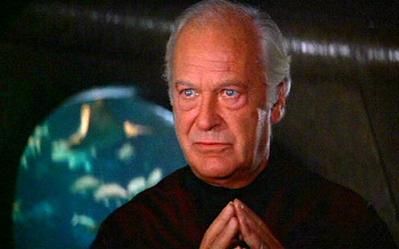
(Bond has an amusing line where he asks Stromberg for how much he’s planning to blackmail the world in order to prevent him from carrying out his plan. This line is a bit of a holdover from early stages of the script, where Stromberg was supposed to be an agent of S.P.E.C.T.R.E. However, the S.P.E.C.T.R.E. connection was dropped because Eon Productions had lost the rights to use the evil organization a few years earlier.)
After supervising the launch of the two submarines, now crewed by his own men, Stromberg leaves, taking XXX with him. Bond escapes from his captors and frees the British sailors, who then release the Soviet and American seamen and, after raiding the armory, battle Stromberg’s mercenary forces. They prove unable to penetrate the Lipurus’ fortified command centre which is protected by a solid steel wall. Bond removes the detonator from a nuclear missile and sneaks it to the front of the wall. Once it explodes, the sailors are able to take command of the ship and send new targeting instructions to Strongberg’s crews. So when the two hijacked submarines fire their missiles, they end up destroying each other.
The Liparus begins to explode (in stages, of course) so the sailors reboard the Wayne and escape. The sub’s commander receives orders to sink Atlantis but Bond convinces him to delay the attack until he has time to go rescue his Soviet counterpart. He uses a jet-ski, which, at the time, was a device most people hadn’t seen before, to reach the base. Stromberg sends the elevator for 007 when he arrives and attempts to drop him into the tank with his tiger shark. But the spy manages to brace himself against the elevators walls to avoid the trap. He then confronts Stromberg and shoots him dead.
Before he can go rescue Amasova, Bond fights Jaws on the railing above the shark tank. As in their previous encounter, our hero proves unable to best the hulking henchman but uses an electromagnet to snare him by the teeth and dump him into the pool with the shark. Why does the room feature a large electromagnet? Fuck you, that’s why! The marine predator proves to be no match for the seven-foot-tall goon. Takes a lot more to kill this guy, it seems.
Bond reaches Ammasova just as the American submarine fires its torpedoes at Atlantis. The two agents manage to make it to an escape pod as the base sinks beneath the waves. 007 opens up a bottle of champagne as XXX takes his gun and informs him, at gunpoint, that the mission is over. However, she chooses to forgo killing him to instead make love with him. We see Jaws surface in the middle of the Mediterranean Sea, not having drowned in Atlantis’ destruction. As for Bond and Amasova, they are picked up By a British warship and discovered making love inside the pod by M and General Gogol. Roll credits.
In some of my earlier essays, I mentioned that I prefer the more serious, grounded Bond adventures to the more fanciful ones. But even though this is definitely a more fanciful adventure, what with its submersible cars and indestructible henchman, I really do enjoy this film. There are those who feel that Moore’s tenure in the role was marked by excess and silliness, but I feel that these elements, when used correctly and in moderation, can be part of an overall excellent film. And this film is definitely one of the best ones of the series. It is helped by some amazing action scenes, such as the ski jump in the pre credit sequence and the excellent car chase in Sardinia.
As far as Roger Moore’s performance, it’s not perfect, but it’s definitely a step up from his work in The Man With the Golden Gun. In particular, he has two scenes where I think he does excellent work. In the scene at Max Kalba’s Egyptian nightclub, he noticably flinches when XXX brings up his dead wife. it’s not a flashy bit of acting, but it’s a nice, understated reaction to what is clearly a sensitive issue for Bond. In the scene in Sardinia where 007 admits to killing Amasova’s Russian lover, he does a great job of balancing the gravitas of the moment with the character’s “it was him or me” rationale to the incident. It’s a nice way to illustrate that, as affable as Moore’s version of the super-spy is, he’s still an assassin who knows the risks of his profession.
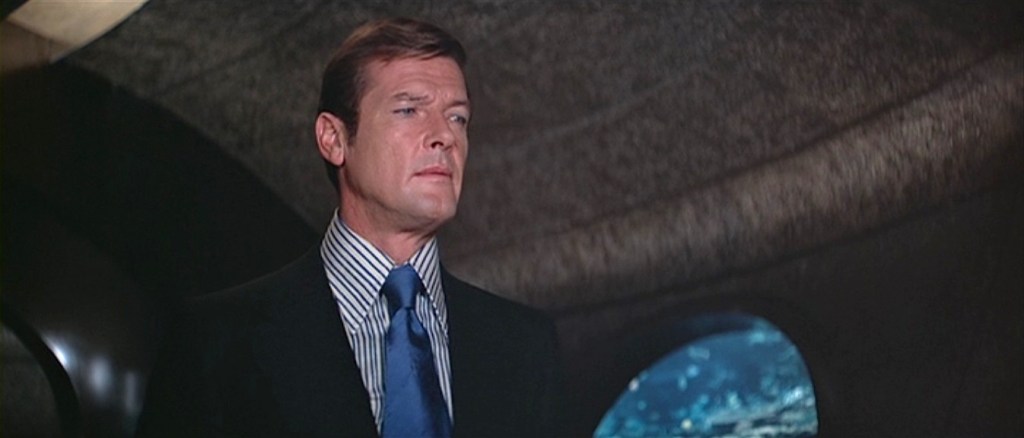
Unfortunately, Bond does come off as a jerk in a few other scenes. He’s especially dismissive of XXX’s vow to kill him after the scene in their hotel room in Sardinia. You’d think he’d be a little more respectful of her abilities and her determination by now, but he seems to treat her threat like a joke. It’s unfortunate because the rest of his performance in the film is pretty good. I blame the screenplay more than the actor in this case.
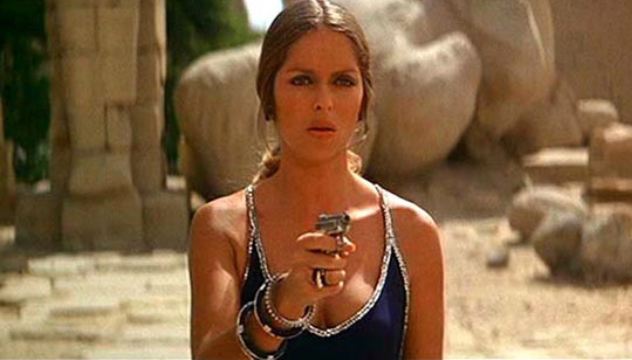
Barbara Bach, as Major Amasova, was the series first real attempt to make a female character who was supposed to be Bond’s equal. In some sequences, she does seem to be a match for him. She even manages to knock him out and steal the microfilm they’re both after when they relax on a riverboat in the Nile. But in other sequences, she does seem to be an inferior agent to her male counterpart. What’s especially sad is that, once Stromberg takes her away after explaining his master plan on the oil tanker, she becomes nothing more than a damsel in distress, another useless character who needs to be rescued by Bond. I’ve read some opinion pieces that call Bach’s acting in the film wooden, but I disagree. I think it was a deliberate attempt by the filmmakers to frame the Russians as a repressed, joyless people. It’s not exactly accurate, nor particularly enlightened, but I think it was a deliberate choice that they made and Bach played the character the way they asked her to.
If the film has a weakness, it’s the villain. Curd Jürgens doesn’t give a bad performance, but the character just isn’t all that interesting. He doesn’t have the class or the flash of some of the classic bond villains. Heck, I’d even say Kananga and/or Largo were more interesting than he was. He’s got a couple of interesting bases that he operates out of, but he himself Just doesn’t do much for me.
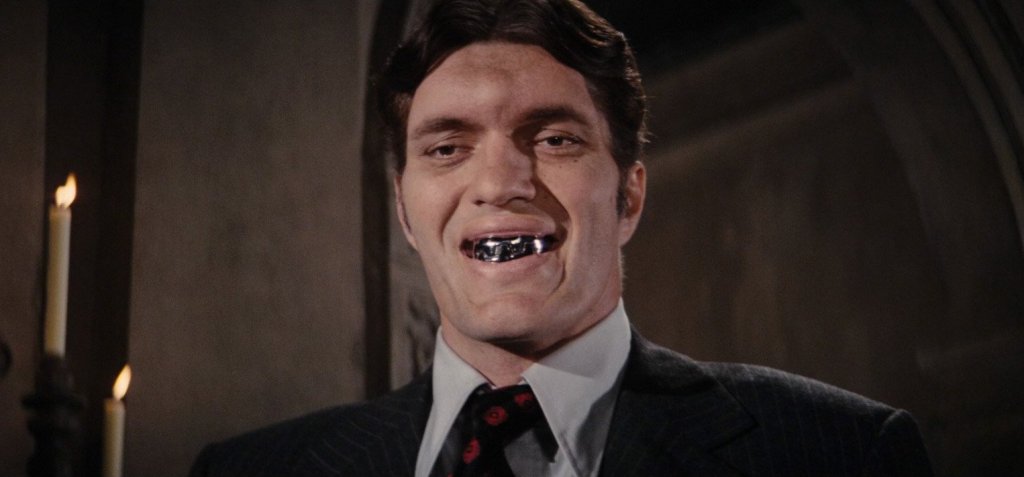
Jaws, on the other hand, is definitely a high point of the film. Whenever I see a list of everyone’s favorite Bond henchman (or henchwomen in some of the more modern films), he’s either #1 or #2 behind Oddjob. He is a little like Goldfinger’s valet in that both characters were physically imposing brutes that Bond could not defeat through regular means. Also, they both got electrocuted at some point. Some may take issue with Jaws’ invulnerability to almost anything, whereas Oddjob, as imposing as he was, was still a regular human being. Jaws can survive anything including an encounter with a killer shark (the filmmakers’ sly jab at the killer shark movie from a few years before, clearly implying that their Jaws is tougher than the other Jaws). The film toes a very fine line regarding the ridiculousness of his invulnerability. I think they stay on the right side of that line in this film whereas his appearance in the next one will get too silly. But your mileage may vary.
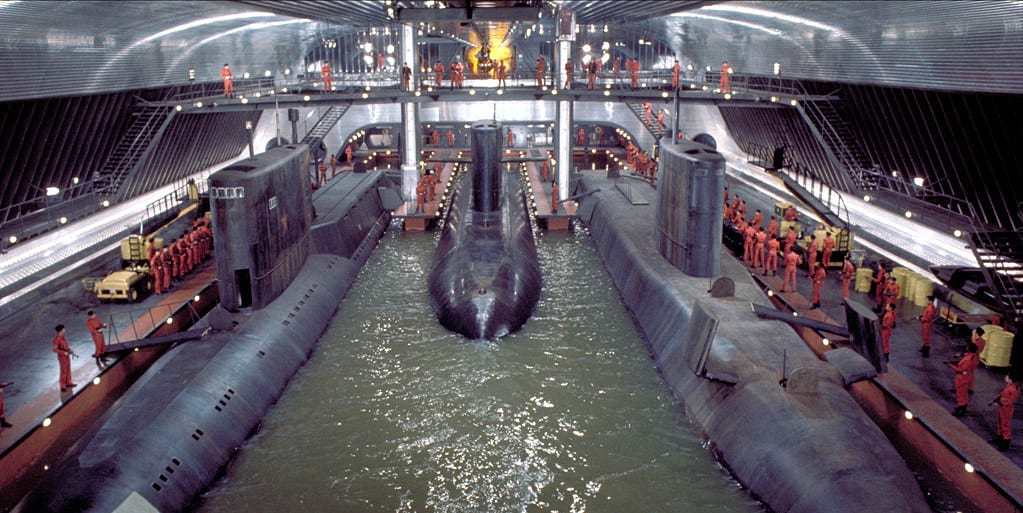
Another point in the film’s favor is that it’s got scale! I mentioned that I like the design of Atlantis, but I also want to call attention to the Liparus. More specifically, the inside of the tanker, which is just a colossal set. It may be hard for modern audiences to appreciate this, but when this film was made, there was no CGI or matte paintings involved. To house the submarine dock set, the Bond producers had to build the world’s biggest soundstage, fill it up with water, and figure out a way to light the damn thing. On this last point, production designer Ken Adam ran into so much trouble that he had to call in a friend of his to help him out. That friend? Just a film director by the name of Stanley Kubrick. You might have heard of the guy.
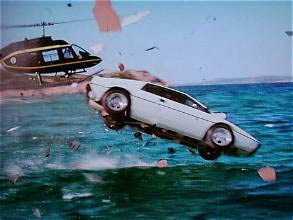
Another nice element of the film is the Lotus Esprit S1, which replaces the Aston Martin DB5 as Bond’s primary vehicle. Since the Moore era is when I started watching the films, and especially seeing them in theatres, this car is the Bond car I grew up on. It’s a sleek, sexy-looking vehicle and it’s well-featured in the car chase where it acquits itself quite well. Sure, it turning into a submersible vehicle is a little far-fetched. OK, it’s a LOT far-fetched. But it’s still a fun element of the film.
(Fun fact: At the time of this writing, August 2026, Moore is the only James Bond actor never to drive an Aston Martin in any of his Eon-produced films. He did, however, drive a DB5 in The Cannonball Run, where he played a fictionalized version of himself.)
One last thing to mention about this film is its soundtrack. It was not composed by regular Bond composer John Berry Because, for tax related reasons, he couldn’t work in the United Kingdom when the movie was being made. Instead, the music is by Marvin hamlisch, who makes frequent use of synthesizers, as was common in a lot of the popular music of the period. It’s not necessarily bad, but it really does make the music a product of its time.
But this is a minor complaint I have with the film. As is what, in my opinion, is something of a plot hole in the film’s third act. What’s amusing about this plot hole is that, a variation of it already appeared in a previous Bond film that had been directed by Louis Gilbert. Gilbert returned to helm this film, and while I don’t think he plotted the films or had anything to do with the writing, it’s kind of odd that the same strange plot element pops up in both films. In my essay on You Only Live Twice, I mentioned that it was strange that S.P.E.C.T.R.E. had kept the captured astronauts and cosmonauts alive for Bond to rescue when he invaded the volcano base. In this film, 007 frees the captured British and Soviet sailors from the submarines at the beginning of the film. My question is, why was Stromburg keeping those men alive? By my count, it’s been at least four days since they were captured at the beginning of the film. So you’d have to feed these guys, escort them to the bathroom (their holding areas didn’t seem to have any toilets) and keep them alive and well for no apparent reason. Stromberg never mentions that he plans to use them to repopulate his world under the sea, so why was he keeping these guys around?
But aside from that, The Spy Who Loved Me is a top-tier Bond adventure. It’s notable for being the first Bond film to completely abandon the plot of its source novel. However, in defence of the film’s producers, I shoukld mention that Ian Fleming himself thought the book was poor and asked them not to use the plot if and when they ever adapted the novel. The film was a huge success when it was released and is still well-regarded today. It might even have been the top-grossing film of 1977, had another adventure film not come along and out-grossed it. That adventure film was set in space, causing the Bond producers to play copycat one last time this decade. That movie, you might have heard of it.

Final verdict:


Leave a Reply