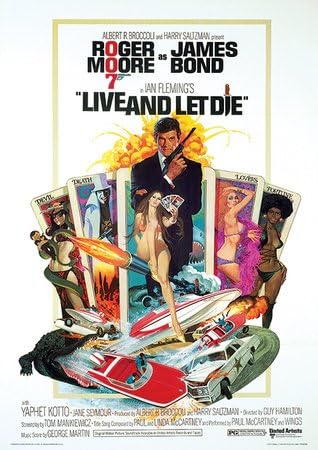
Let’s face it, the 1970s were not James Bond’s best decade. In the 1960’s, Bond films defined action cinema and inspired a slew of imitators. But once the 70s started, the movies no longer set the bar in action films. Instead, they started to follow trends. I mentioned in my review of DIAMONDS ARE FOREVER that it’s car chases were outclassed by those of several other films of the same era. But at least that film was, for all its faults, still doing its own thing. You don’t look at it and think “Oh, they’re just copying this other movie”. Sadly, you could say that about a few of Bond’s 1970s outings. In this case, it’s the decade’s Blaxploitation films.
And then there’s the matter of Roger Moore, the new Bond. He’s often compared to Sean Connery, seen as his replacement once you discount George Lazenby’s one-and-done performance in the role of Bond. A lot of fans I talked to when I was growing up felt that Connery was the better Bond. I don’t agree. It’s not that I think Moore was the better one, just that I don’t think there’s such a thing as a “better” Bond. To choose one over the other, we’d have to agree on what makes a good Bond and what doesn’t. I’ve never heard of any objective criteria for the character being established, so I feel the discussion is pointless.
However, I will point out one tidbit that informs my opinion on the merits of both actors. I saw an interview with Connery where he said that he only read one Bond novel when he took the role. I saw another with Moore where he also claims he only read one of the novels. While I don’t know what novel Connery read, in Moore’s case, I highly suspect it might have been Goldfinger. Early in the book, the author explains that Bond is feeling out-of-sorts because he just finished a mission where he had to kill a guy, and he didn’t like doing it. It’s the part of his job Bond most dislikes. Moore always played Bond as a slightly reluctant assassin in a way that Connery didn’t. Since Connery was the first to play the character to great acclaim, many fans see his interpretation as the “correct” one, but I don’t think it is. I think each actor brought their own interpretation to the character and none is more valid than the other.
(Fun fact: At 45 years old, Moore is the oldest actor to be cast as Bond in an Eon-produced film. In the Bond novels, 45 is actually the retirement age of double-O agents. Despite his age, I think he still looks pretty spry.)
Before Moore is introduced in the film, we get the pre-credits sequence. A trio of men are killed separately. One at the U,N, Building in New York City, one staking out a soul food restaurant in New Orleans and the last in a voodoo ceremony taking place somewhere in the Caribbean (We’ll later learn that it’s the fictional island country of San Monique). Interestingly, This is only the second of three Bond pre-credits sequences not to have Bond in them and the other two at least feature a Bond look-alike.
The credits play over a Paul McCartney & Wings song. The film’s music score was composed by former Beatles producer George Martin. Regular Bond composer John Barry was absent for the first time since joining the EON-Produced series with From Russia With Love due to scheduling conflicts with a theater musical he was scoring. I’m a big fan of Barry’s contributions to the series, and when somebody else scores the movies, I tend to notice. But in this case, I think Martin did a fine job. Since music is inherently subjective, you may feel differently. However, the film’s producers liked the title song so much, a singer in a later scene does a version of it as well. This is the first and thus far only time a Bond theme song appears in both the credits and during the film itself.
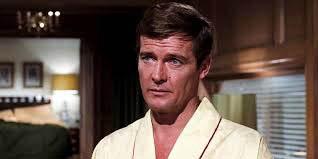
After the credits end, we’re introduced to our new Bond, the aforementioned Roger MoorseUnlike the introductions of both Connery and Lazenby, there’s no camera edits or shadows to obscure the character and wet our appetites for the new guy. He’s immediately seen cozying up to an Italian lady in his bed. I’ve never seen any interview with the producers explaining why they introduced this new actor in a matter so dissimilar to his predecessors, but I can hazard a guess. Connery wasn’t really a big star when he first played Bond and George Lazenby was a complete unknown when he did. But audiences, especially British and American ones, were familiar with Moore from his starring in The Saint, an espionage-adjacent TV series that ran in England for six years and in the US for three. Ironically, it was his commitment to that series that prevented Moore for being cast as Bond eleven years before when the producers wanted him but had to settle for Connery. I think the producers, aware that their audience would already know who Moore was, figured they didn’t need to build him up with a flashy introduction.
M shows up at his house (the first time we ever see Bond’s home) and assigns him to investigate the deaths of the three men from the pre-credits sequence, all British intelligence operatives. While he’s explaining the mission, Monneypenny arrives and sees the half-naked Italian sneaking around. She helps Bond conceal her presence from M, which I gotta wonder about. Why would it be bad for M to find out Bond had made love to an Italian? He wasn’t on the job and it happened at Bond’s home. Would this have been that shocking in 1973? Anyway, Bond also demonstrates how his watch is a powerful magnet developed by Q, who doesn’t appear in this film at all (The producers wanted to downplay the gadgets for their new actor’s debut).
Bond flies to New York while an unseen woman performs a tarot card reading predicting his arrival will bring violence and destruction to her allies. When Bond arrives, he grabs a ride in a taxi driven by a CIA agent. As Bond talks to his old friend Felix Leiter (played, as usual, by a different actor than in previous films) over a car phone, his driver is shot by a poison dart from a white “pimp-mobile” (as Leiter will refer to it later). The taxi crashes but Bond emerges unscathed. Having noted the attacking car’s licence plate number, he provides it to Leiter who Informs him that the car is registered to a voodoo shop in the city. Bond makes his way there and looks around, eventually discovering the pimp-mobile in a hidden garage. He surreptitiously manages to spot San Monique’s leader, Dr. Kananga and his entourage getting into a bronze Cadillac in the garage and leaving. Bond hails a cab and instructs the driver to tail the Cadillac. He eventually ends up in Harlem where he enters a soul food restaurant.
No sooner has the spy sat down at a table inside before a revolving wall moves him into a hidden portion of the building filled with African-American criminals. It is there that he first encounters Solitaire, a beautiful Tarot card reader working for the syndicates leader Mr. Big. Bond also meets Mr. Big’s associate, Tee Hee, a large man with a prosthetic claw instead of a right hand. The henchman uses it to disable the Englishman’s pistol and then leaves. Bond makes small talk with Solitaire and when she invites him to pick a card to see his future, he draws the Lovers card. It is at this point that Mr. Big himself shows up and tells his underlings to take Bond out back and shoot him. Once outside, the Englishman tricks and fights off the two goons trying to kill him. After he’s taken care of them, a CIA agent who had been tailing Bond steps up and accompanies him away.
After checking in with Leiter, 007 travels to San Monique to continue his investigation of Dr. Kananga. He stays at a hotel where one of the local entertainment acts is a troupe of performers led by Baron Samedi, who we will later learn is also in the villain’s organization. In his suite, Bond is threatened by a poisonous snake quietly slipped into his room, but he dispatches it by turning an aerosol can into a makeshift flamethrower. Our hero then meats Rosie Carver, an attractive CIA agent sent to assist him. However, Rosie proves to be a little jittery, freaking out at the dead snake and at a black hat left on Bond’s bed as a warning.
The next morning, the spy awakens to find a tarot card has been included with his hotel breakfast. We see him going to a local tarot shop, presumably to find out more about the card. Then, he and Rosie go to the docks where they hire a fishing boat to take them to another part of the island, the area where Bains, one of the British operatives from the pre-credits sequence, was killed in a voodoo ritual. The boat owner is revealed to be Quarrel Jr,, presumably the son of Bond’s ally Quarrel, whom we met and saw die in Dr. No. However, in the book on which this film is based, it was actually Quarrel himself who aided 007 with his boat. This was possible because the film series adapted the books out of order. Live and Let Die was the second novel of the series and introduced Quarrel, while Dr. No was the 6th, where the man died. What’s amusing about the introduction of his son is that the actor playing him was only 12 years younger then the man who played Quarrell. Guess the character got intrested in the ladies very early in life.
Rosie offers to guide Bond around the area but seems unsure of where she’s going. She and the spy end up making love in a clearing but Bond pulls a gun on her. The tarot card he received at breakfast was the Queen of Cups, indicating a duplicitous woman. Rosie attempts to sweet talk her way out of this situation, then implores Bond that Kananga will kill her if she talks. She sees a voodoo effigy in the bushes that terrifies her. She flees the area but another effigy fires a dart that kills her.
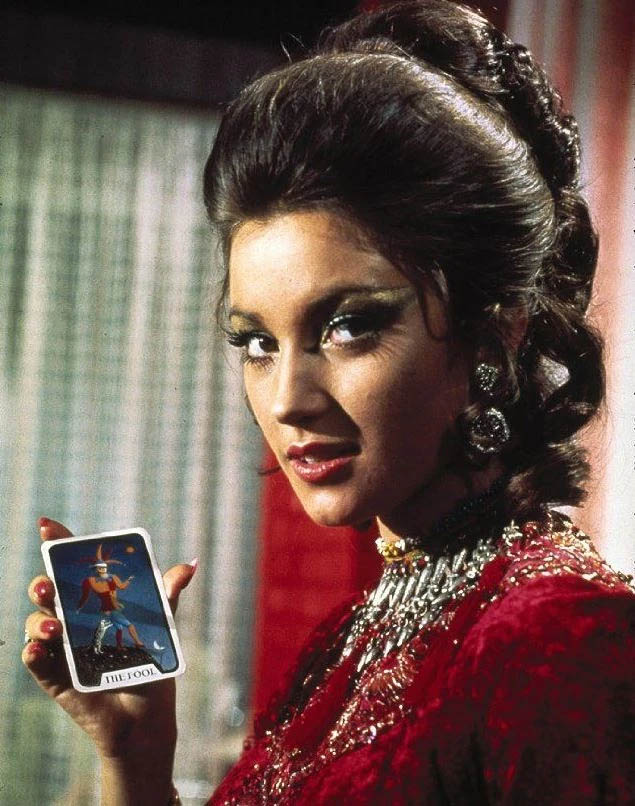
After a quick scene of Kananga being upset with Solitaire over her inaccurate reading of the tarot cards regarding Rosie’s death, the scene shifts to later on that night with Bond using a hang-glider to stealthily infiltrate Solitaire’s Manor. She finds him playing with her tarot deck and when he challenges her to pick a card to see their future, she once again picks the Lovers card (Though we do see that the wily spy has stacked the deck with nothing but Lovers cards). This leads to the two making love and afterwards, Solitaire explains that losing her virginity means that she has lost her powers.
The next morning, Bond and Solitaire leave her manor. They encounter Baron Samedi, sitting in a field and playing a flute, though his instrument turns out to be a hidden radio that he uses to inform Tee Hee of their whereabouts. After 007 and Solitaire discover a plantation full of concealed poppy plants, they are attacked by a helicopter and flee the area. They make their way to a small town where the local police have been contacted by Kananga and ordered to arrest them. The two escape on an old double-decker bus and a car chase between the bus and some motorcycles and a police car ensues. Eventually, Bond and Solitaire escape the authorities and make it to Quarrel Jr.’s boat. As the three sail away from the island, Bond deduces that the poppy fields likely mean that Kananga is distributing heroin. He orders Quarrel Jr. to take them to the U.S.
007 and Solitaire arrive in New Orleans, where one of the other British operatives from the pre-credits sequence, Hamilton, was killed. However, they leave the airport in a taxi that turns out to be driven by the same cab driver that took bond to Harlem earlier in the film. He imprisons them in the backseat and drives to a local airfield where a group of Kananga’s henchman are waiting. They plan on flying our hero high enough that they can throw him off the plane and let him fall to his death. However, Solitaire causes a distraction that allows Bond to run off and hop into a small plane that he drives around the airfield and ends up wrecking while escaping the goons. Unfortunately, he does not manage to take Solitaire with him on his escape.
Bond meets Leiter In New Orleans and finds out there’s a Fillet of Soul restaurant in town, part of the same chain as the restaurant where he met Mr. Big earlier in the film. It is also the restaurant Hamilton was staking out when he was killed. The two spies go there but when Leiter is called away for a phone call, their table lowers itself down to the basement and Bond once again finds himself confronted by Mr. Big, who has Solitaire and Tee Hee with him. The crimelord demands to know if the spy made love to Solitaire but the Englishman refuses to answer, insisting that he will only talk to Kananga. So the villain removes his disguise to reveal that he actually is Dr. Kananga, operating as both the supplier of heroin to the United States and the urban mobster overseeing its distribution to cities across the country. His plan is to give it away for free, thus driving other criminals out of the drug business and creating more addicts that he can cater to once he has a monopoly on the heroin market. Having explained his scheme, he repeats his question about the spy’s relationship with Solitaire. Once again, 007 refuses to answer, so Kananga asks the woman to answer a question about the serial number of Bond’s wristwatch. The tarot cards don’t help her anymore so when she gives the wrong answer, this tells the scoundrel that she has lost her power of divination.
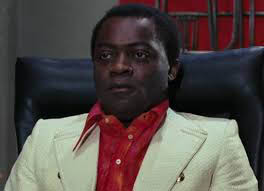
Tee Hee takes Bond away to a crocodile farm that doubles as a drug processing laboratory. The henchman shows off the dangerous reptiles here and leaves the secret agent on a small outcropping of rock while the gangplank leading to it is retracted. Because this is a Bond film, the henchman leaves and doesn’t ask anybody to stick around to make sure the crocodiles devourer our hero. This gives him the opportunity to try and attract a nearby rowboat with his magnetic watch. But for once, his gadget fails him as the boat is held in place by a rope tied to a tree. So Bond is forced to run across the backs of three floating alligators to get to safety. Once there, he opens the gates to let the beasts crawl into the laboratory, which he then sets on fire with the help of some gasoline soaked rags.
(Fun fact: The crocodile farm was actually owned by a man named Ross Kananga. He told the producers who were scouting his farm for the movie that he could run across the backs of crocodiles, so the producers had him do it and then included it in the film. They were so impressed by the stunt that they named the villain after him, because in the book the movie is based on, he’s only known as Mr. Big and has no other identity.)
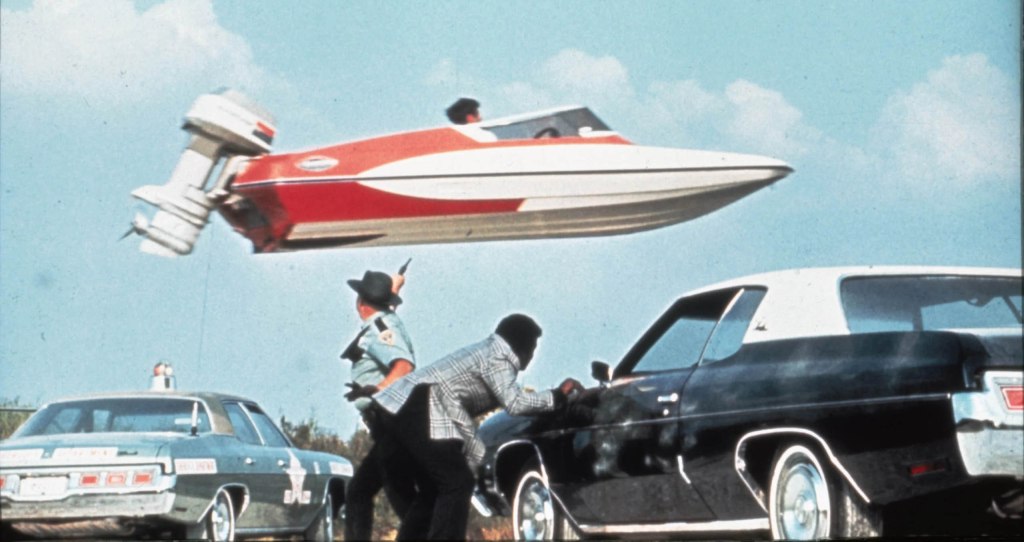
Bond hops into a speedboat and takes off on the rivers of Louisiana. Kananga’s henchmen persue him and an exciting chase sequence begins. It goes on for quite a while, but I personally don’t mind as it never wears out its welcome. Along the way, a local sheriff gets involved with the chase without knowing why the spy or all these goons are chasing each other all over his parish. There are many boat jumps across roads, boat crashes into cars, a wedding is ruined and finally, Bond dispatches the chief henchman, Adam, (not named in the movie, identified in the credits) by throwing gasoline in his face and causing him to run his boat into a ship that promptly blows up.
The action shifts back to San Monique where a nighttime voodoo ritual very similar to the one we saw in the pre credits sequence is taking place. This time, however, the intended victim is Solitaire. Nearby, Bond, Leiter and Quarrel Jr. are on the latter’s boat. Leiter stays behind as the other two swim to the island where Bond goes off to rescue Solitaire and Quarrel Jr. plants explosives in the poppy fields. 007 arrives in time to shoot the voodoo priest about to have a poisonous snake bite the captive woman. But then Baron Samedi appears and attacks Bond with a machete. The spy makes quick work of him and the Baron falls into a casket full of snakes, presumably being killed. Or maybe not (see below).
Bond and Solitaire stand next to the gravestone Samedi rose from and they are lowered into Kananga’s secret underground headquarters. Why does he need a secret underground headquarters? Because he’s a Bond villain, that’s why! They evade the guards until they get to the main room that has an aquatic tunnel leading to the sea. There, Kananga congratulates them on their exploits. His men found a bag of equipment Quarrel Jr. left on the beach for Bond and is fascinatrd by a strange gun that the secret agent explains is an anti-shark weapon that fires compressed air bullets. The villain uses it to blow up his couch and explains that his poppy fields have only been lightly damaged by the explosives so his plans have not been thwarted at all.
He has Bond and Solitaire tied to a winch that he normally uses to load heroin onto a subterranean monorail. He then cuts the Englishman’s arm so that he bleeds into the nearby pool which attracts a nearby shark. But before the spy and the former clairvoyant can be dumped into the water, Bond uses his watch’s magnet feature to attract a compressed air bullet and the watch’s buzz-saw feature (Did you know the watch was also a buzz-saw? Neither did I, but apparently it is) to cut his way loose. He fights Kananga and the two end up in the water with the shark. Bond shoves the compressed air bullet into Kananga’s mouth which causes him to inflate and blow up. This is possibly the stupidest demise for a Bond villain in the entire series. 007 gets out of the water, and he and Solitaire head out.
The scene shifts to a railway station where Bond and Solitaire are saying goodbye to Leiter before getting on a train to New York. Inside their cabin, the two enjoy themselves and are preparing to make Love when Tee Hee shows up and fights the spy. He’s bigger and his claw appendage makes him a dangerous adversary, but Bond manages to sever the device’s cables, causing it to lock around the exterior window’s metal frame bar. Our hero then flips Tee Hee out the window to his death. Bond then resumes his romantic embrace of Solitaire and we cut to the front of the train where we see Baron Samedi cackling at the audience as the credits begin to roll.
Samedi’s final appearance, coupled with the proven ability of Solitaire to see the future, proves that, in the James Bond movie universe, magic seems to exist and is quite effective. It’s never mentioned again in any of the subsequent films but it’s out there.
Overall, I think this is a fun Bond movie, though it’s not without its flaws. Its main strength is the villains. Kananga is a good antagonist and his henchmen are all excellent. Tee Hee is definitely menacing, but he casts a pale shadow next to the amazing Baron Samedi. The Baron is to the James Bond universe what Boba Fett used to be to the Star Wars universe. He’s there, he looks amazing but he doesn’t really do much. Still, I love the guy. Geoffrey Holder, who played the character, has such amazing presence. Every time he’s on screen you just can’t take your eyes off of him. Even the minor henchman such as the cab driver or the physically imposing Whisper, make an impression. Overall, I would put this group of baddies at the top tier of Bond villain rankings. Kananga himself might just be OK, but his support staff is really excellent.
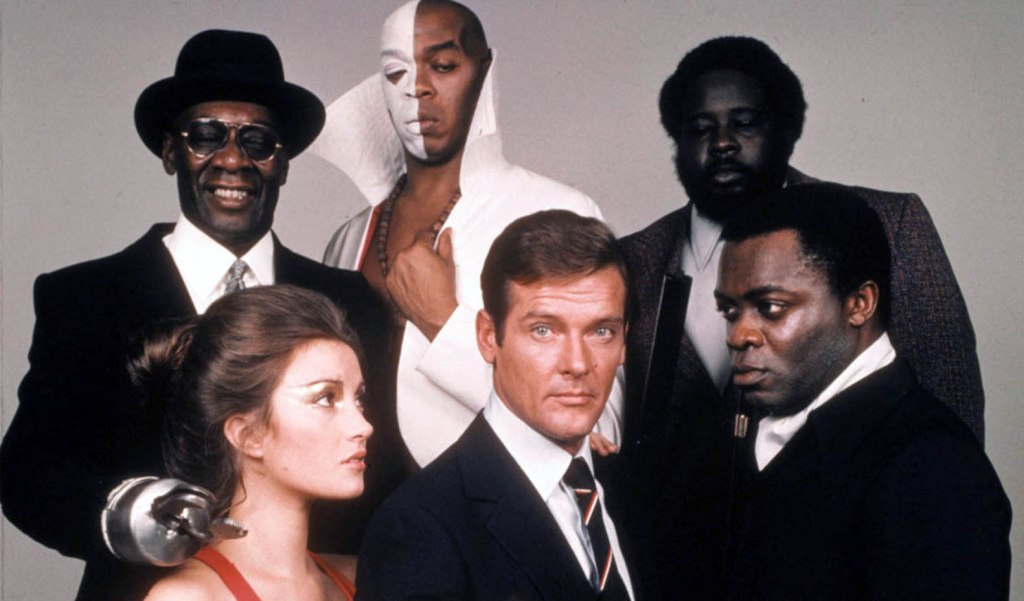
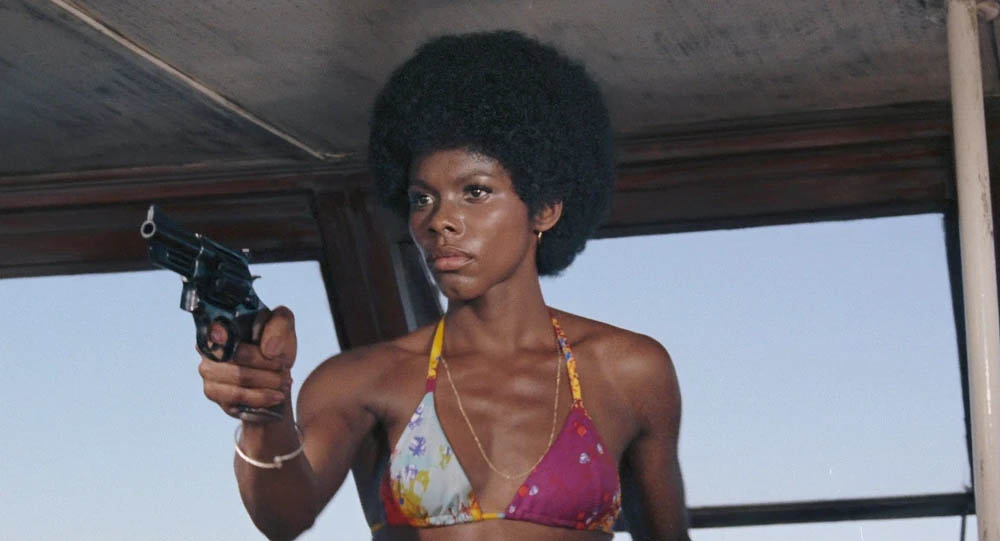
With one exception. Rosie Carver is terrible, just terrible. She screams way too much, is very useless and just adds nothing to the movie aside from being attractive. I’ve said this before about other women in previous Bond film reviews but as we go along, some of them just get more and more useless Ann Rosie is the most useless thus far. It’s also troublesome because she is the first African-American Bond Girl and she sets a very low standard. The good news is, by and large, the Bond Girls will get mostly better from here on in but yeah, she’s a pretty low point of the film and the series in general.
Another character that some people in the fandom don’t like much is Sheriff J.W. Pepper, the Louisiana lawman who adds comic relief during the speedboat chase. I don’t mind having him there, as I find he adds a bit of local colour to the scene. It’s true that actor Clifton James plays him a little broadly, maybe too broadly compared to the rest of the film. But still, I don’t mind that choice and I do find him amusing. If you disagree, at least take heart that he’s only in that one portion of the film.
Another thing that bothers me about this Bond adventure is that it is so rooted in a particular time and place by its blaxploitation element. In the previous Bond films, there was a timeless quality to the material. The cars might be old, but they still look good today. I could also imagine that when I saw people in a particular scene. there are still people who look like this somewhere in the present day. Even in, say, the Florida hotel that we see early in Goldfinger, I can imagine there are people dressed like that getting a tan and playing gin rummy by a hotel pool somewhere. Sure, the fashions may have changed a bit, but overall, not that much. However, when Bond is wandering around Harlem in this film, I know this is not taking place anywhere contemporary. Also, I’ve never been a fan of Bond adventures that take place in the United States, and this makes two in a row. I like my Bond locations to be exotic and, honestly, this one just doesn’t deliver. The Caribbean locations they use for San Monique look nice, but we’re not there long enough to get a sense of the place.
That being said, I do consider this film a great improvement over Diamonds Are Forever because that movie didn’t have any particularly great action sequences, and this film does. The speedboat chase sequence is amazing. The stunt work is great, the editing is top-notch an it just moves along at a brisk pace that I can’t help but enjoy. The other action set pieces aren’t quite as great, but they don’t bother me either. This is much better than the last film and its moon-buggy debacle..
I want to point out how assured Roger Moore is in this performance. Far more assured, I would say, than George Lazenby was when he took over the role. At no point do you see Moore hesitate or wonder what he’s doing in a Bond film. From his very first scene, he’s comfortable in the role and never makes you question why he was cast. I remind you that, had the Bond producers had their way, Moore would have been the original Bond actor in the movies. Moore is helped by the fact that he’s allowed to add his own mannerisms to the role without relying too much on previous ones adopted by Connery. For example, he never orders a vodka martini in the entire film, but that could be because the only time he orders a drink is in soul food restaurants which may not have the required vermouth he likes. But in the battle at the voodoo ritual, which is the only time he ever fires a gun, he’s not using Bond’s usual Walther PPK but instead a Smith and Wesson .44 caliber revolver. He also doesn’t smoke cigarettes, like Connery did. The producers would reintroduce some of those familiar elements, such as the vodka martinis, in later films, but for now, Moore got to do his own thing and apply his own interpretation of the role
(A shame that he wouldn’t be allowed to do that in the next film, but that’s another story that I’ll get to very soon.)
Jane Seymour does a good job as Solitaire, though her character is a little more passive then some of the other Bond Girls from previous films. Aside from causing a distraction at the airfield In Louisiana, she never really helps Bond in any way. She mostly acts as eye-candy that the hero sometimes has to rescue. But she’s still way better than Rosie Carver. She’s also got a weird makeup motif going on when she’s being the high priestess of tarot cards. Incidentally, her credit at the beginning of the movie says that the film is “introducing” her, giving you the impression this might have been her first film production. But she’s been in other movies before. Still, I’m hard pressed to think of an actress who used a Bond Girl role as a stepping stone to such a successful career. There have been other very good actresses in Bond films, but most of those were established actresses when they got the gig, whereas Seymour was still relatively unknown when she got the job.
And while I discussed my issues with the mpvie’s specific cultural moment, I do want to say that the film has a great ambiance about it. In the Harlem sequences especially, they really don’t hide the fact that Bond is very much a fish out of water, surrounded by an environment full of danger that he’s one step behind a lot. The fact that he doesn’t fit into this place makes it all the more interesting without getting silly.
The film also marks a turning point in the series as very few of the following movies will feature villains trying to blackmail the world powers, which had been a staple of the S.P.E.C.T.R.E.-driven stories of the past films. From here on in, it’s mostly individuals who are pursuing their own agenda. Kananga, for example, isn’t trying to take over the world, he just wants to make money. One really wonders how the heck British intelligence ever became interested in him in the first place.
So while this is not the best Roger Moore Bond film, it’s far from the worst either. I put it in the mid-tier of his seven films and it’s a good launch to what would be a successful series of films for this period of the Bond canon. It would have its ups and downs, and we will cover them as I go along this series. Unfortunately, the next film is one of the downs.
Final Verdict:


Leave a Reply