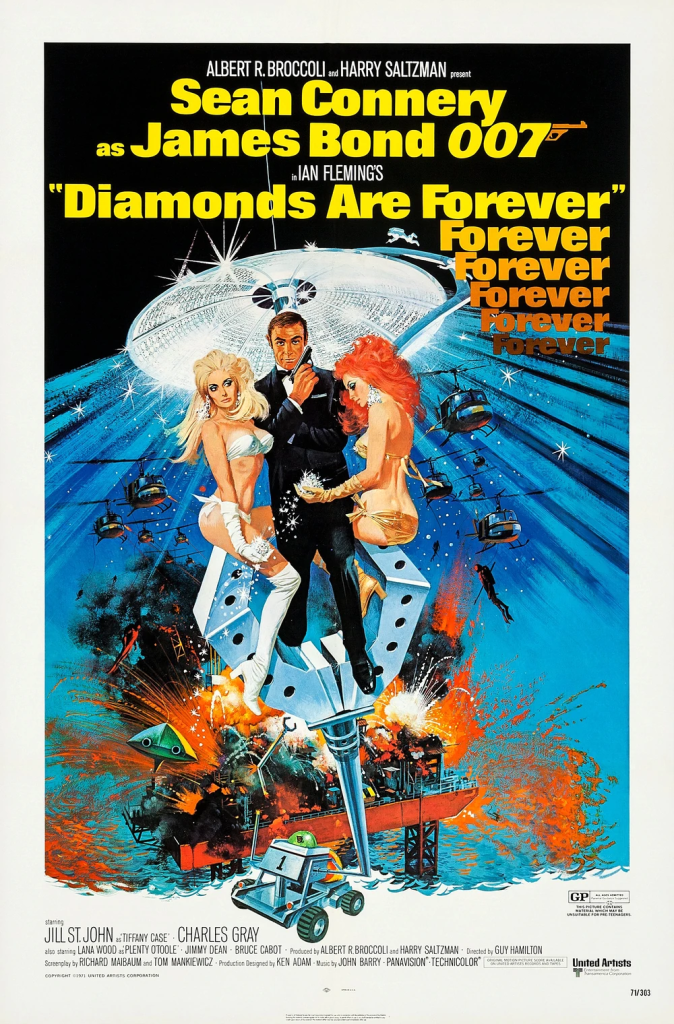
When I started reading magazine articles and opinion pieces on the James Bond film series, I started to encounter a commonly held opinion amongst it’s fans. It states that the Roger Moore films are goofier and less grounded than the more serious series entries that starred Sean Connery. I don’t share that opinion, and as proof, look no furthur than this film. If you equate Moore’s tenure as Bond with goofiness, then this is the most Roger Moore Bond film that Roger Moore never starred in.
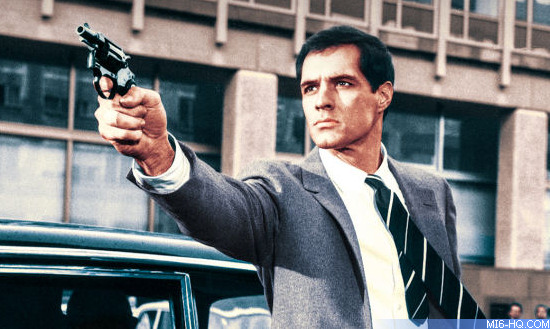
I might as well address the elephant in the room right off the bat. After Sean Connery walked away from the Bond series in 1967, what brought him back? Well, EON Productions had already cast American actor John Gavin as the super-spy (Gavin is best known for playing Sam Loomis in Alfred Hitchcock’s Psycho). However, the United Artists studio, which had released the six EON Bond films, was worried that after peaking with Thunderball, the box-office earnings of both You Only Live Twice and On Her Majesty’s Secret Service had seen a steady decline. So the studio contacted Connery and agreed to pay him $1.25 million to return one last time. This was the highest salary paid to an actor for a film role at the time.
It should be noted that for Connery, it was less about greed and more about it being an acknowledgement of how much of the series’ success he’d contributed to. He’d watched the producers and directors get rich off the Bond films while he’d earned nothing more than a journeyman actor’s salary. He felt that he’d earned a bigger cut of the pie than he’d been given, and this payday was his vindication. It is to the late actor’s credit that, according to UK newspaper The Guardian, he donated most of his salary from this film to the Scottish International Education Trust, a charity he’d founded.
So now Connery was on board for one last go at the role (in an EON-produced Bond film, that is), Don’t feel too bad for John Gavin, as EON decided to pay him his full $100,000 salary anyway despite his never shooting any footage as Bond. He is the only Bond actor cast in the official Bond series to never actually make a Bond film. There might be an alternate universe where Gavin played an American Bond in a series of films throughout the 1970s, but we don’t live in that universe.
The EON team has never admitted to doing this on purpose, but the film does a sneaky job of trying to make you forget On Her Majesty’s Secret Service ever happened. For one thing, the late Tracy Bond is never mentioned in this film. For another, Connery’s previous outing as Bond, You Only Live Twice, had ended with him on a raft in Japanese waters. This film opens with him beating up a guy in Japan (and not being easy on the décor while doing so). Almost as if we’re picking up the story with Bond never having left Japan at all.
After this, he pops from one location to the next, roughing up various people until he finds Blofeld in a subterranean laboratory. Once again, the villain is recast. This time out, he’s played by Charles Gray, who had previously appeared in You Only Live Twice as the ill-fated Henderson. Bond interrupts the surgery that’ll turn some guy into the villain’s perfect duplicate. Bond kills the patient by drowning him in a pool of mud, but then Blofeld shows up with a trio of goons that Bond quickly dispatches. After a bery quick fight, Blofeld is thrown to his death in the mud as well. Cue the opening credits, wherer the title is sung by Shirley Bassey, resuming her vocal duties from Goldfinger. It’s my favourite of her three Bond theme songs, but your milage may vary.
Once the credits have completed, Bond is briefed on a ring of diamond smugglers he’s assigned to investigate. His briefing is intercut with scenes of two assassins, Mr. Wint and Mr. Kidd, dispatching the people involved in the smuggling. Bond assumes the identity of Peter Franks, a member of the ring and he travels to Amsterdam to pick up a load of diamonds from Tiffany Case, an attractive link in the criminal chain. After this initial meeting, Q informs Bond that the real Peter Franks has escaped from custody. Bond rushes to Tiffany’s and gets into a fight with Franks, eventually killing him. It’s a nice, enjoyable fight and the enclosed space makes it quite tense. Unfortunately, the action sequences in the film kinda go downhill from here.
Bond smuggles the diamonds into the United States by stashing them into Franks’ body. When he and Tiffany fly to Los Angeles, we see that Wint and Kidd are on the same plane, and this leads to one of three instances regarding the two were I’m confused by their behavior. You see, so far in the film, they’ve killed every link in the chain of criminals that’s involved in the diamond smuggling operation once their victims had played their role in moving the diamonds. They got the diamonds from a dentist and killed him. Then they blew up the helicopter pilot who the dentist normally used to get the merchandise out of South Africa. They gave the diamonds to an old lady in Africa and she gave them to Tiffany in Amsterdam before the assassins killed the old lady there. So once Tiffany gave Bond the diamonds, she’d fulfilled her role in the scheme and should have ben targeted for murder. But for some reason, Wint and Kidd don’t try to kill her until later in the film.
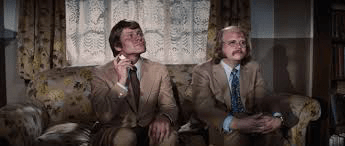
In L.A., 007 encounters Felix Leiter (played by a different actor than in his previous appearances, naturally) who informs him the C.I.A. is likewise looking into these smugglers. He’s also met by a trio of attendants from Slumber Inc., a Las Vegas funeral home. One hearse ride later, he’s watching Franks’ body get cremated. A few minutes later, the diamonds have been extracted and brought to Bond, who drops them off in the home’s remembrance garden and is immediately knocked out by Wint and Kidd. They place him in a casket and send him to the crematorium’s oven, but he’s pulled out by Vegas comedian Shady Tree, who had picked up the diamonds and discovered they were counterfeit. Bond, still pretending to be the actual Peter Franks, informs Tree and Mr. Slumber that he’ll give them the real diamonds when he gets a payout in real money. Then he leaves.
The spy investigates Tree and finds him performing at the Lincon Lounge of the Whyte House, a hotel owned by reclusive industrialist Willard Whyte. When the show’s over, Tree goes backstage where Wint and Kidd are waiting to off him. Bond finds his body and then goes to the casino floor where he has a run of luck at the craps table. Not only does he net himself $50,000 (about $400,000 today) but he also picks up a curvy opportunist named Plenty O’Toole. When he takes her to his hotel room, they find the Slumber Inc. attendants waiting, two of which throw Plenty out the window wearing only her underwear, though she survives her fall when she lands in a pool (Actress Lana Wood performed the stunt herself while being mostly naked, but was ogled by hotel guests during the fall).
Bond is ready to take on the goons but they leave and he finds Tiffany Case naked in his bed (because of course she is). She offers to partner up with him to keep the diamonds for themselves and sneak out of town. The next day, she picks up the diamonds but betrays Bond and delivers them to the next link in the smuggling chain. This time, Wint and Kidd try to kill her because she’s of no more use to the smugglers anymore. Or, well, they sorta try. See, what happened next doesn’t really make a lot of sense unless you watch the film on home video and have access to a deleted scene that was cut from the film’s theatrical version.
In the deleted scene, we see that, after Plenty O’Toole survived her fall from Bond’s hotel room, she grabbed a towel to preserve her modesty and snuck back up there, only to find Bond making love to Tiffany. She then surreptitiously grabbed Tiffany’s wallet and found her home address. Since the scene was cut, it doesn’t make a lot of sense that when Tiffany returns home after handing over the diamonds, she finds Bond waiting for her and Plenty’s dead body in her pool’s deep end. Bond suggests that Plenty stumbled in only to be mistaken for Tiffany and killed. But with the deleted scene, her presence there makes a little more sense, right?
Not really. You see, earlier in the film, Wint and Kidd had spotted Tiffany on the plane from Amsterdam. Kidd even commented on her appearence. Since they’re the ones who have been dispatching all the other links in the smuggling chain, one presumes it was them waiting at Tiffany’s house. When Plenty showed up, they would have known she wasn’t Tiffany, so Bond’s theory can’t be correct. Now it’s entirely possible Wint and Kidd dispatched Plenty because she was an inconvenient witness to their presence there. But then why leave the house when they went there to kill Tiffany and hadn’t done the job yet?
And, dear God, why didn’t anybody make a quip that Plenty sure has a habit of ending up in pools?
I don’t wanna sound like I’m obsessing over a minor character’s demise, but it just bothers me when there’s plot holes like this. And unfortunately, this isn’t even the most egregious one in the movie! A worse one is coming up.
Now that Tiffany sees that her life is in danger, she throws her lot in with Bond and helps him witness the diamonds being picked up by Professor Doctor Metz of Whyte Industries. Yes, he uses both titles. Bond stows away in Metz’ van as he drives back to an isolated laboratory. And of course, nobody ever looks in the back of the van. So Bond infiltrates the base and sees that the diamonds are being used in conjunction with some sort of satellite. But Bond is discovered and must flee the facility, And this is where the movie takes a big detour into Goofytown.
007 flees into a different part of the compound where a moon landing is being faked. When he’s spotted, he runs across the moon set. One of the “astronauts” tries to grab our hero but is too committed to moving in slow-motion to be a danger. Bond jumps into a moon rover and drives his way through a wall to get to the desert outside. Security guards give chase with cars and ATVs in a fairly ridiculous sequence where, frankly, you never get the feeling of Bond being in any danger.

Once out of the compound, our hero reunites with Tiffany and the two drive back to Las Vegas where the police, erroneously believing them to be dangerous saboteurs, tries to apprehend them. The subsequent car chase through the Vegas strip is better than the moon buggy escapades, but not by much. It’s kind of sad because, up until this one, the action sequences in Bond movies had pretty much set the standard that other films followed. However, when Diamonds Are Forever was released, movies such as Bullitt, Vanishing Point and The French Connection had already come out and featured car chases that put this one’s to shame. Worse, the chase features a flub that the production had to fix in a haphazard manner. To escape the police, Bond drives into an alley that becomes too narrow for the car. So he drives half of it onto a ramp to get the car balanced on it’s right (passenger) side wheels. But when the car comes out of the narrow alley, it’s balancing on its left (driver) side wheels. There’s a shot of Bond and Tiffany in the car that was inserted and the angle of the shot rotated to indicate the car switching sides, but it’s a cheap and unconvincing attempt to fix the error.
007 and Tiffany end up in a ritzy room at the Whyte House and, despite being instructed to sit tight for now, he goes outside to invade the penthouse with a grappling hook gun and confront the elusive Willard Whyte. But Bond finds that it’s Blofeld who’s taken up residence there and assumed the kidnapped industrialist’s identity. Bond shoots one of the two Blofelds he’s confronted by but finds he’s only succeeded in killing another of the villain’s doubles.
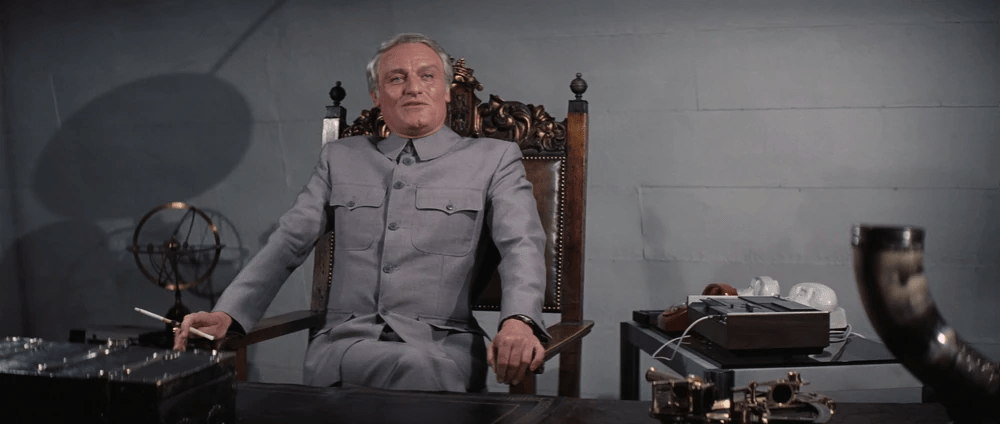
The actual Blofeld holds him at gunpoint, plays coy about his plans for the diamonds and dismisses Bond by directing him to an elevator. Bond gets in and is promptly gassed unconscious.
Wint and Kidd drive Bond to a construction site and place his sleeping body in a pipe that is then buried underground by workers who don’t notice the unconscious spy in it. Bond wakes up in a pipeline where he shares a quip with a rat and then disables a pipe welding machine. When a maintenance crew shows up to fix the machine, Bond is released and off he goes.
So, to sum up, Wint and Kidd had an unconscious Bond in their clutches and instead of putting a bullet through is head, throwing him off the roof or even driving him over to Slumber Inc. for another try with the crematorium, their decision was to just dump him at a construction site and hope nobody noticed and he’d just vanish? I know some of the deathtraps Bond finds himself in during these movies are a little elaborate and far-fetched. But this one is just plain incompetent! For crying out loud, I’m pretty sure I could have gotten out of this one myself, and I’m nowhere near being in Bond’s league!
The saddest part is, we’re talking about Las Vegas in the 1970s. There were plenty of people walking around that place who knew how to kill a guy and dispose of a body quietly.
Bond pretends to be one of Blofeld’s henchmen on the phone and tricks the villain into revealing where the real Willard Whyte is stashed. Bond and his C.I.A. allies get to the house but Bond decides to go in alone for some reason. Inside, he finds Bambi and Thumper, two agile young women who proceed to beat the crap out of him for a few minutes until the three end up in a pool where he gets the upper hand (There’s a lot of women in pools in this film). The industrialist is rescued.
Back at the Whyte House, Tiffany is talking to Q on the casino floor when she spots Blofeld leaving. More specifically, she notices he’s carrying his white cat. Despite her having no reason to know who Blofeld is or about his affinity for white Persian cats, she goes after the villain and ends up trapped in a car with him. Did I mention that Blofeld was dressed as a woman during all this? Well, he was.
Bond and Whyte go to the laboratory where 007 saw the satellite earlier in the film only to find it gone. They learn it’s been shot into space where it’s been using the diamonds to power a large laser targeting nuclear weapon sites in the U.S., U.S.S.R. and China. Blofeld intends to auction off nuclear supremacy to the highest bidder. Back at the Whyte House, a chance remark by Bond while looking over a map of the wealthy man’s holdings leads to Whyte mentioning one he doesn’t recall having. An offshore oil rig near Baja, California.
Bond travels to the rig where he finds Blofeld and Tiffany, who has adapted quite well to being at the villain’s side. Blofeld explains to Bond that the satellite is controlled by computers on the rig and that a control tape is needed to keep them operational. Bond manages to swap the control tape with a music tape and plants the control tape into the back of Tiffany’s bikini. So that the guards won’t find it when he’s searched. Meanwhile, Blofeld decides that since the world’s governments haven’t responded to his demands yet, he’ll blow up Washington D.C. once the satellite is in the correct position ten minutes hence. Bond unties a weather balloon to signal a troop of nearby helicopters that it’s safe to attack the base now that the computers are disabled.
Unfortunately, Tiffany erroneously thought Bond had given her the tape because he wanted it placed in the computers. So she tells him she did it and he realizes she’s made them operational again. As 007 is locked in a tiny room, she tries to put the decoy tape back in but Blofeld spots her. All this tape nonsense turns out to be irrelevant as the helicopters attack. Bond escapes and Blofeld decides to abandon the rig in a bath-o-sub. The sub is lowered into the water by a crane on the rig that Bond takes control of. He lifts the sub out of the water and rams it into the computer control centre repeatedly. The center blows up, the satellite is neutralized and Blofeld seems to finally have been killed so Bond and Tiffany get off the rig.
The scene shifts to a dock where Whyte and Felix Leiter are saying goodbye to Bond and Tiffany as they embark on a cruise to London. Later on in their cabin, a quiet moment is interrupted by Wint and Kidd, who are passing themselves off as waiters bringing the pair a banquet of delicacies including a time bomb placed inside a cake. Bond becomes suspicious of the waiters when he gets a whiff of Wint’s aftershave, which he smelled twice before. Once before he got knocked out in the Slumber Inc. garden of remembrance and the other when he woke up in the underground pipe. His suspicions are confirmed when Wint gets a detail about the meal’s wine incorrect and the assassins attack.
When Kidd attempts to stab the spy with a pair of flaming meat skewers, Bond douses him in the wine which sets the assassin on fire. After Kidd jumps overboard, Tiffany tries to help 007 but only succeeds in uncovering the bomb. Bond overpowers Wint, attaches the bomb to him and throws him overboard. It explodes as Wint hits the water and presumably kills the injured Kidd as well.
Although I have some nostalgic affection for this Bond film (I’m not sure, but I believe it may have been the first I ever saw), that nostalgia isn’t enough to gloss over the film’s many imperfections. I’ve mentioned quite a few thus far, but there are some others I’m leaving unaddressed. Making things worse is the fact that I’ve seen all the Bond movies and, by comparison, almost all of them are better than this one. That being said, the Bond films were never really meant to be looked at as chapters in a larger story. (Until the Daniel Craig entries) They’re individual stories and so I think the best way to look at Diamonds Are Forever is to analyse it on its own, outside of the overall series. Personally, I’d have loved to see a more direct sequel to On Her Majesty’s Secret Service but I’m not gonna penalize the film for not being that. No, I’m simply gonna look at what the film is trying to do and see how well it did it.
A 007 film should have action, and this one does, but even for its time, the action sequences are underwhelming. Bond’s tussle with Peter Franks in Amsterdam is good, but the other sequences aren’t. I’ve already highlighted a few that left me unimpressed, but I neglected to mention the helicopter assault on the oil rig. The sequence is shot and edited in such a way that doesn’t provide any suspense or thrills. It’s a lot of noisy stuff going on, and then being over, nothing more. Lackluster action scenes are a real liability in a Bond movie, I’m sorry to say.
I also wanna mention that the special effects in this movie aren’t great. Even for the time, they were sub-par. Probably has a lot to do with the fact that almost 17% of the movie’s budget ended up going directly into Sean Connery’s pocket. This forced EON Productions to cut some corners, and special effects is where it’s most noticeable.
Speaking of Connery, let’s talk about his performance. It’s fine. It lacks some of the intensity he previously brought to the role, but then again, this isn’t a particularly intense script. So, I’d say he brings the right tone to the material. He places his tongue firmly in cheek and, considering he’s required to drive a moon module around in one scene, that’s probably the best approach. He’s about as engaged with the material as he’s required to be, and that’s about all I can say about him. Except that he still looks great in a dinner jacket, of course.
As Tiffany Case, Jill St. John seems game to try and make her Bond Girl one of the series’ toughest and most independent. She doesn’t succeed, but it’s the script’s fault, not hers. About mid-way through the movie, Tiffany becomes completely incidental to the film’s plot. During the climax, she’s just a useless character filling out a bikini. Filling it out nicely, but that’s hardly something any other Bond Girl couldn’t have done as well.

The only other characters of note are the villains, so let’s talk about Blofeld first. I’m not the first to say this, but Charles Gray makes for a very campy Blofeld. Not quite as over-the-top as a villain from the 1960s Batman TV show, but he’s in that general ballpark. I don’t wanna knock the actor too much because, as I said before, this is a silly story so the more serious takes on Blofeld we saw from Donald Pleasence or Telly Savalas wouldn’t have fit in here. But he still feels less like a proper Bond villain than a caricature of one at various times in the movie. And the method of his demise is very underwhelming. I know I’m trying not to think too much of the other films, but considering this is the villain who we’ve seen in five of the seven EON Bond films up to this point, it’s a real let-down to see the premier Bond villain get taken out like such a chump.
At least Mr. Wint and Mr. Kidd are fun to watch. Yes, I’ve pointed out a lot of plot holes that have to do with their actions throughout the film, but they themselves are a very engaging pair. It’s nice to see a pair of killers who are good at their job and seem to enjoy what they do. They’re not really creepy, just easy-going and cheerful. Their scenes may not always make a lot of sense in the context of the story, but damned if I’m not happy to see ‘em show up anyway.
A problem I have with the film is one that you may not share, but I’ll get into it anyway. In my review of Goldfinger, I talked about how I didn’t think Kentucky was an exotic enough location for a Bond film. Well, I’m not really a fan of Las Vegas either. It doesn’t help that I’ve been there, so a lot of its charm and mystique is thus lost on me. But generally, I just don’t think 007 should spend too much time in the United States. The travelogue aspect of Bond’s adventures is a big selling point for me, and I might have enjoyed the film more if more of it had taken place somewhere else. If you feel differently, chances are you’ll appreciate the film more than I did. And if that’s the case, I’m happy for you.
So, in the end, what we have here is a pretty silly Bond adventure with very little thrills. It’s unfortunate that this would cap off Connery’s tenure in the official EON series, though he’s not the only actor playing the role this happened to. And he would come back in the 1980s. Oddly enough, the same could kinda be said for Blofeld. But for now, this is one of my least favourite Bond films.
Final verdict:

ADDENDUM; A week after posting the above review, I came up with a theory that explains some of the plot inconsistencies in the film. Especially those that concern Plenty O’Toole’s death. Follow me down the rabbit hole.
I pointed out that Wint and Kidd had been killing every link in the diamond smuggling chain as soon as their victims had fulfilled their part in the smuggling operation. Except Tiffany Case. After she handed the diamonds to Bond, she was not targeted for assassination.
I also pointed out that, when Tiffany spots Blofeld leaving the Whyte House and went after him, it didn’t make a lot of sense because she has no knowledge of the man.
And I tried, to no avail, to explain why Plenty O’Toole was drowned in Tiffany’s pool, since Bond’s explanation that she was mistaken for Tiffany makes zero sense,
But what if all of this was an intentional sub-plot about a lovesick man attempting to seduce the beautiful smuggler and the murderous fiend who thwarted his plans?
Wint and Kidd were murdering all the people involved in the diamond smuggling operation at Blofeld’s orders. But my theory is that Tiffany Case was specifically excluded from the kill list. Why? Because Blfeld was attracted to her. While putting together the smuggling chain, he might have seen a picture of her and become attracted to her charms. As that picture of her I posted above shows, there’s a lot to be attracted to. After all, Blofeld may be an evil villain, but he’s still a man with a man’s desires. Desires that can’t be sated simply by stroking a white Persian cat.
So what I believe may have happened is that after ordering his assassins to leave her unharmed, Blofeld contacted Tiffany. I think it happened after Bond confronted him in Whyte’s suite atop the Whyte House. He gassed Bond and left him with Wint and Kidd, we saw that in the film. But I believe Blofeld then invited Tiffany up there (easily done since she was staying in one of his hotel’s suites) to persuade her to join him as he blackmailed the world. She was non-committal and he let her think about it. This is why Tiffany went after Blofeld when she spotted him leaving the casino later on. Because she’d already met him. It’s the only explanation that makes sense. This is borne out by the fact that, once she was in his clutches, Blofeld didn’t harm her but was happy to let Tiffany wander around scantily-clad, exactly what a love-struck megalomaniac would do.
So with this in mind, Let’s re-examine the scene where Tiffany returns to her home to find Bond waiting for her and Plenty dead. I’ve already explained that Wint and Kidd knew what Tiffany looked like and wouldn’t have mistaken Plenty for her. On the off-chance that it was the goons from Slumber Inc. who did the deed, they also knew what Tiffany looked like. They’d helped her break into Bond’s hotel suite earlier in the film. So they weren’t going to mistake Plenty for her either.
When Tiffany found Plenty dead in the pool, she’d already betrayed Bond by handing over the diamonds to the criminal syndicate. So Bond knew she was untrustworthy but he still needed her on his side to help guide him up the diamond smuggling chain. Since sleeping with her and appealing to her greed hadn’t made her loyal, he surmised that the only way to make sure she stayed on his side was to convince her it was in her own best interest. So my theory is that he’s the one who murdered Plenty and stuck around to convince Tiffany that the criminals had deemed her expendable, when that actually wasn’t the case (no pun intended) at all. And poor Tiffany fell for it!
If you examine the events of the film, I think you’ll see my theory makes way more sense than the film’s story. And my theory explains awayall the plot holes I mentioned in my review. Except or Wint and Kidd dropping off Bond’s sleeping body in a construction site, That still makes no Goddamn sense.


Leave a Reply