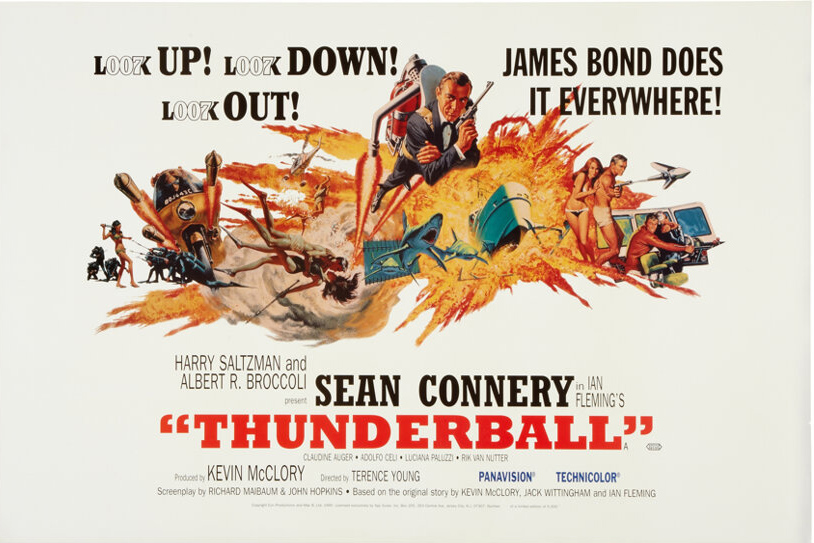
Thunderball was, until the release of Skyfall, the top-grossing Bond film if you adjust the earnings for inflation. It was released in 1965, when Bondmania was at its height. Sean Connery, playing the super-spy for the fourth time, was now very comfortable in the role. It featured groundbreaking (for its time) underwater sequences and a plot that stayed close to Fleming’s original novel. On paper, you’d think this movie had all the elements to be a classic.
And yet, when I look over the ranking lists of most Bond fans, this movie very rarely makes an appearance near the top. This is not recency bias. All of those lists have some of the 60s capers near the top (From Russia With Love and Goldfinger, usually). Meanwhile, Thunderball can usually be found somewhere in the middle to lower half. Nobody seems to think that it’s a bad film, but it’s not really regarded as a great one either. Of course, it’s commonly accepted that every film in the series is somebody’s favourite, and if this is yours, you’re not wrong in that opinion. It just so happens that I don’t share it.
I have two major issues with the film, which I’ll get to in good time. But let me talk about the plot first, ‘cause it starts off pretty strong. After being absent from the last film, S.P.E.C.T.R.E. returns with its most ambitious plot yet. It’s replaced an officer of the flight crew of a NATO bomber with a doppelganger. He kills the other airmen mid-flight and lands the plane, which is carrying two nuclear bombs, in the waters off the Bahamas, where the villains take possession of the bombs and stash them in a hidden underwater cave. They then send a message to the world’s governments demanding a ransom of 100 million pounds sterling (280 million American dollars), a pretty hefty sum in 1965.
Bond gets involved when he’s recovering at a spa near the airbase from which the doomed plane takes off. He runs afoul of one of the S.P.E.C.T.R.E. operatives involved in the plot who also happens to be staying at the spa. They both try to kill each other using the spa’s equipment and both fail. So while the film spends a while at the spa, the only thing that happens of any note to the overall plot is that the body of the NATO officer who was killed and replaced is left at the spa and Bond sees it. This will give him a clue that will lead him to the Bahamas later on, but it’s an awful lot of time spent to set up a reveal that could have been done a lot quicker. It also bothers me that while at the spa, Bond blackmails a physiotherapist into sleeping with him. It’s not as bad as forcing himself on a woman, like he did with Pussy Galore in Goldfinger, but it’s still pretty creepy.
This is also a marked difference from the preceding Bond films. We normally discover most of the villains’ schemes more or less as Bond investigates them. He gets assigned a case at the beginning of the film, and we find out what’s going on more or less as he goes along. Here, we see the entire plan put into motion and only afterwards does Bond get assigned to investigate. There’s nothing inherently wrong with this story technique, save that it robs us of any surprises for a good portion of the movie’s runtime. We’re clued into the villains’ scheme early and then we spend most of the movie waiting for Bond to catch up to us.
My real issue with the film isn’t that we know more than Bond, it’s that the movie takes its sweet time having him clue in. Because he saw the NATO officer’s dead body hours before the plane disappeared, he decides to investigate the dead man’s sister, Domino, in the Bahamas and finds her in the company of the scheme’s architect, Emilio Largo. Bond knows Largo’s up to something, but it takes him three days before he confirms that the guy’s got the bombs. In the meantime, there’s quite a few sequences that don’t really have any payoff. For example, Bond scuba-dives under Largo’s yacht to confirm it has an underwater hatch. He’s discovered and Largo’s men chase him away by throwing hand-grenades in the water. We never really feel Bond’s in danger while this is going on. He eludes them by ditching his wetsuit and hitchhiking along a deserted road where he’s picked up by none other than Largo’s henchwoman, Fiona Volpe. As they banter, she floors her car’s accelerator and Bond looks uncomfortable with her dangerous driving. The soundtrack gets loud and ominous, indicating the hero is in danger. But the two get to the hotel they’re both staying at without any incident, so why did the music try to freak us out?
Another example comes later on when Bond sneaks around Largo’s estate under cover of darkness. He gets caught by a goon, their fight takes them into a pool where he kills the goon, evades some sharks and then just leaves. In no way, shape or form does this advance the plot in any way. Bond learns nothing, finds nothing, the villains aren’t affected by his visit and we just move on to more of Bond accomplishing very little.
The final bit of time-wasting I want to mention doubles as a bit of a continuity error. Soon after Bond arrives in the Bahamas, Q shows up to give him some equipment. He gives him a watch that also acts as a Geiger counter and a camera that can take pictures underwater. On the morning of S.P.E.C.T.R.E.’s deadline, Bond finds the missing plane and dead crew. Later on, he tells Domino that her brother is dead and that Largo’s responsible. He gives her the camera and shows her how to use the Geiger counter within it. Except that it’s his watch that has the Geiger counter, not the camera. If the camera had a Geiger counter, why didn’t Q mention it in the earlier scene? Also, wouldn’t that make the Geiger counter in his watch rather redundant? Anyway, it’s all for naught ‘cause Domino’s snooping is quickly discovered by Largo. And when he sent his men to get the nuclear bombs, Bond replaced one of the villainous scuba divers so he already knew the bombs were on the yacht anyway. So his earlier recruitment of Domino accomplished nothing except putting her in danger.
All of this leads to the final confrontation between Largo, backed by his villainous divers, and a team of U.S. Coast Guard divers off the coast of Miami where the villain plans to detonate one of the bombs. This is perplexing to me as, throughout the film, we saw that the world’s governments were planning on paying the ransom S.P.R.C.T.R.E. was demanding. So then why blow up a city? Anyway, the fight underwater goes on for a very long while. I can’t help but think that the filmmakers, excited that they could film great underwater footage, decided to cram in a lot of it into the film without really thinking about if they really needed this much of it.
So, the villainous divers are killed, Largo swims back to his yacht, Bond and Largo fight on the bridge and when Largo gets the drop on Bond, he’s shot in the back by Domino. They get off the runaway yacht, which blows up (because of course it does) and the movie’s over.
There’s not a lot in this movie for me to recommend it to someone who’s new to the series. Connery delivers a good performance but everyone else is just kinda… there. Largo’s not a bad villain, but there’s nothing that really makes him interesting to watch. He likes to gamble, he enjoys the company of beautiful women, he orders a lot of henchmen around, and that’s about it. He wears an eyepatch and S.P.E.C.T.R.E. head Blofeld refers to him as “Number 2”, so if you were wondering who the Robert Wagner/Rob Lowe character in the Austin Powers franchise was based on, now you know. But aside from that, there’s not much to Largo.
But at least I remember Largo’s name. His crew of baddies is an assortment of bland characters who make no impression whatsoever. Even Largo himself admits they’re bland when he says one of them doesn’t drink, smoke or make love before wondering what the guy does. I dunno man! Why don’t you tell me! He’s your henchman, after all. Near the end of the film, another of Largo’s henchmen is ordered to torture Domino. This same guy tortured one of Bond’s allies until she killed herself with a cyanide capsule earlier on*. But this time out, he suddenly gets repentant and lets her loose. For his trouble, Bond throws him off Largo’s yacht with a life preserver. Considering the amount of sharks we’ve seen swimming around those waters, I seriously doubt that guy made it. And don’t ask me his name ‘cause I don’t have a clue.
* = Bond’s ally Paula, who dies while being tortured, is played by Martine Beswick, returning to the film series after having played one of the gypsy girls in From Russia With Love. One of the rare two-time Bond Girls.
The notable exception to the gang of bland villains is Fiona Volpe. When she’s on-screen, the film invariably gets more interesting. She’s the first true femme fatale of the series. In the last two films, Bond’s charm was powerful enough to cause two different women to switch sides and join his cause. Volpe, after sleeping with Bond, does not. She even calls him out on it.
- “But of course, I forgot your ego, Mr. Bond. James Bond, who only has to make love to a woman and she starts to hear heavenly choirs singing. She repents, then immediately returns to the side of right and virtue. But not this one!”
I’ll say this for her; she may be a villain, but she knows who she is and what she’s about. She’s efficient, intelligent, cold-blooded and a real firecracker of a character. My only issue with her character is that she’s killed off way too early in the film. Once she’s gone, the film is definitely lessened by her absence.
Incidentally, the way she’s dispatched, being shot in the back while dancing with Bond, is a matter of some debate in the online Bond fan community. The way the scene is shot and edited, it’s unclear whether or not Bond was aware of the gunman’s presence. If he was, and he spun Fiona deliberately to use her as a human shield, then this marks one of the few times in the series where Bond deliberately kills a woman. Usually, women in the series who are killed die at the villain’s hand or at the hands of a secondary character (like how Rosa Klebb was killed by Tatiana Romanova at the end of From Russia With Love).
The last character to mention is the main Bond Girl of the film, Domino. She’s a kept woman who becomes intrigued by Bond because he might represent a way out of the unfortunate situation she finds herself in. She’s not the worst Bond Girl I’ve ever seen, but she’s not as interesting as her predecessors Honey Ryder, Tatiana Romanova or Pussy Galore. This makes her the blandest one so far in the series. Once she’s introduced and leads Bond to Largo, she’s served her narrative function and becomes inessential until the very end of the movie, when she kills Largo. I’ve seen some online rankings of Bond Girls that rank her in the top ten, usually based on her beauty (actress Claudine Auger came in second place at the 1958 Miss World beauty pageant). Since all Bond Girls are beautiful, I look for other qualities and sadly, Domino just doesn’t have much to offer. As far as Bond Girls go, I rank her middle of the pack, personally. I’ve seen a lot worse, but I’ve also seen better.
So to sum up, Thunderball is a very uneven film. It has a solid first act and a decent final act but the middle goes on way too long and suffers from a myriad of pacing issues. Connery is above reproach, Fiona Volpe is a great charactr and the location is nice, but there’s very little else to recommend this film compared to other Bond adventures.
Before I end this review, I should mention that there’s an awful lot of dubbed characters in this film. Blofeld shows up in the first half, played and dubbed by the same two actors as in From Russia With Love. Largo and Domino were played by an Italian and French actor, respectively, and their thick accents required they be dubbed by English actors. But the one that surprised me was the character of Patricia Fearing, the physio nurse Bond blackmails/seduces early in the film. Despite actress Molly Peters being English, her voice was dubbed too, for some reason.
And a few words about the pre-title sequence. The S.P.E.C.T.R.E. agent Bond tangles with was played by Bob Simmons, who was usually Connery’s stunt double. Simmons had been the man in the gun barrel sequence in the three previous Bond films. However, it was feared that as theatre screens were getting larger, people might notice it wasn’t Connery so the sequence was re-shot with Connery and used here and his final two films in the series as well. Also, the jet pack Bond uses to escape is real! It’s very difficult to use and only lets you fly for about a minute but it really exists and has since the 1960s!
Final verdict:

 Dr. Gorgo's Den