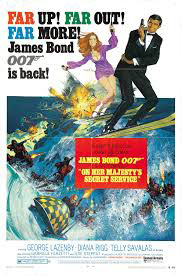
I’ve heard it said that every Bond film is somebody’s favourite. Yes, even Die Another Day. However, after decades of being a Bond fan and reading countless articles and opinion pieces, not to mention watching many a YouTube video on the subject, I’ve never seen anybody name George Lazenby as their favourite Bond actor. Even those, like me, who list On Her Majesty’s Secret Service as their favourite Bond film don’t seem to elevate Lazenby to top spot.
It’s possible that Lazenby didn’t make much of an impression because of his brief tenure in the role. EON production took a gamble on the unknown actor (he’d only appeared in a commercial prior to being cast as Bond, and had no lines in that ad) and some consider his performance in this film a little wooden. Another factor that works against him is that everyone in the film outshines him. In the five previous EON films, the producers cast the Bond girls based mostly on how good they looked and put them opposite Sean Connery, confident that he could anchor the scene with sufficient gravitas to make it work. But here, the dynamic was reversed. It was the hero who was cast for his looks and the other actors who had to ground the scenes.
Another knock against Lazenby was that this Bond film is quite unlike it’s predecessors in a key point. It’s the first time we see Bond evolve in the course of the story. Usually, Bond ends the film pretty much the same man he was at the beginning. He’s completed his mission and foiled whatever plot the villain sent his way. He’s a character around whom a bunch of interesting things happen, but he’s not the sort who’s taking us on a character journey. There’s nothing wrong with that sort of character if that’s what the film requires. I can think of several other movie heroes who don’t really grow as individuals and remain constant instead (Indiana Jones comes to mind). But here, Bond falls in love, marries and loses his wife in the course of the film. It’s unfamiliar territory for a series whose fans had gotten used to a certain rhythm to the stories.
On that note, it’s a little odd that the producers cast a neophyte actor in the role when this Bond would be required to do more character work than Connery was ever asked to. It’s a shame Connery had walked away from the role because he had complained that the films were getting more fantastical and he wanted more grounded roles, which is exactly what this film turned out to provide. Other actors would be asked to provide more depth to Bond in some of the subsequent films, but whether Lazenby succeeded in doing so is a matter of subjective vision. I think he did okay most of the time, but you can feel free to disagree.
The final, and I believe the most important, knock against Lazenby is that he was the first replacement in the role of Bond. It’s never easy to take over a pre-established role in a series that has a fanbase. I’m old enough to remember when Star Trek: The Next Generation premiered and how many fans hated the idea of adventures that didn’t feature their beloved Kirk, Spock and McCoy. Or how, when the original cast and writing staff of Saturday Night Live left after the show’s fifth season, the replacements were almost all rejected by the audience.
Now, my take on Lazenby was affected by timing. I got into the Bond series as a kid in the late-1970’s. By that time, it was the Roger Moore era, so it was easy for me to accept that Bond could look and act different from one film to the next because I saw the films out of order, mostly when they aired on network television. At the time, I heard rumours of the one film in the series that starred neither Connery or Moore, but VCRs and video stores weren’t quite on the scene yet, so the story remained a rumour. Then I caught the film when my local station aired it as a midnight movie on a Saturday night and I finally got to take it in. By this point, I had seen all the other films in the EON series so this, to a certain extent, completed my foray into seeing the Bond back-catalogue (I didn’t yet know either version of Casino Royale existed, and discovered them later).
In our most recent viewing of the film, my friend Claire pointed out it does a pretty smart thing in its opening. It begins with Q, M and Moneypenny discussing Bond’s whereabouts and then cuts to him in his car, driving his Aston Martin DBS (not the same model as in previous films) down a beachside road in Portugal. He is passed by a beautiful woman in a convertible who parks nearby as does an intrigued Bond. He sees that she is wading into the ocean to drown herself. He saves her, and this is the first time we see Lazenby’s face. Up until then, lighting and camera angles had kept him obscured. It seems the film wanted us to know this was a Bond film before they revealed the new Bond actor.
Before he can find out who this woman is and why she’s trying to kill herself, a couple of goons appear and threaten our hero. He fights them off and as he does, the woman drives away, leaving him to break the fourth wall as he muses “This never happened to the other fella.”. Cue the opening credits.
I haven’t talked much about the opening credits in my reviews of the previous Bond films, but there’s a couple of details of this one’s that I want to call attention to. For one thing, this is one of the few where there’s no title song, just an orchestral piece. Also, the credits feature images taken from the previous five EON-produced Bond films, indicating that this film, despite starring a different actor, is still part of the same series featuring the same character. It is not a “soft reboot”. But what perplexes me is the inclusion of images of a man hanging from the hands of a giant clock and of an hourglass’ sands shifting. This seems to suggest that the film’s plot will feature Bond in some sort of race against time. However, the subsequent film doesn’t really feature any such plot element. Or, at least, no more so than the last two films in the series.
With the credits done with, we pick up the story with Bond at a ritzy hotel where he learns that the woman he rescued in the prologue is Contessa Teresa “Tracy” di Vicenzo. He encounters her again at the baccarat table that night where he has to bail her out after she makes a bad wager she can’t cover. The two share a drink and she invites him to come to her room later. When he goes, he finds Tracy absent but one of the goons present. A quick fight later, Bond returns to his own room to find Tracy waiting for him there. They spend the night together and the next morning, he finds her gone and learns she’s checked out of the hotel.
Bond is then abducted by the goons and taken to their boss, Marc-Ange Draco who, in addition to being a Corsican crimelord, is also Tracy’s father. He explains that his daughter’s self-destructive behavior is caused by the trauma of losing her philandering husband coupled with an undisciplined upbringing. He asks Bond to keep seeing her, but the spy demurs. It’s only when he realizes Draco might be able to help him track down the elusive Ernst Stavro Blofeld that the two come to an arrangement.
Bond returns to London to check in with MI6 only to find that he’s been taken off the Blofeld case. Incensed, he asks Moneypenny to deliver his resignation to M, but she instead arranges for Bond to get two weeks’ leave instead. Both Bond and M separately thank her for her deft defusing of their conflict. This section is also notable for showing Bond going to his office (the only time we’ll see it in the entire series) and packing up mementos of his past cases. This is another cue to viewers that this Bond is, in fact, the same man as in previous films.
Bond returns to Portugal to attend Draco’s birthday party. When Tracy arrives, she’s surprised and suspiscious of Bond’s presence there. It is to the screenwriters’ credit that they don’t have Bond and Tracy start seeing each other under false pretenses. Instead, Tracy immediately unravels her father’s manipulations and forces him to share his information on Blofeld with Bond without obligation. An impressed Bond pursues Tracy as she leaves and the two begin a romantic relationship in earnest. I’m very glad the story positions Tracy as a strong, smart character who refuses to be a pawn in someone else’s game. It makes her worthy of Bond’s genuine affection instead of just another piece of eye candy. Hard to believe this is the same film series that had its lead blackmail a woman into sleeping with him in Thunderball and flat-out forcing himself on another woman in Goldfinger.
A quick montage follows, showing Bond and Tracy getting closer. It is set to the song We Have All the Time in the World, which is the last song Louis Armstrong recorded before his death two years after the movie came out. Then Bond, Tracy and Draco go to Bern where Bond breaks into a law firm that Blofeld is using to correspond with the College of Arms in London. He finds documents showing that Blofeld is trying to prove he is the reigning Count de Bleuchamp. During this sequence, he uses the only gadget in the film, a large automatic lockpicking device about the size of a modern photocopier. This is a bit of a continuity error as in his previous adventure, Bond had used an X-ray machine the size of a cigarette case to open a safe. What happened to it?
Bond returns to London to brief M on his discovery, get himself reassigned to the Blofeld case and meet with the College of Arms’ genealogist Sir Hillary Bray. Bond will pass himself off as Bray when he goes to meet Blofeld in Switzerland. Bray is played by George Baker, who also dubbed Lazenby’s dialogue when Bond is posing as the genealogist (Lazenby wasn’t aware of the dubbing until he attended the film’s premiere). So, disguised as Bray, Bond goes to the Swiss Alps where he is met by Blofeld’s subordinate Irma Bunt. She escorts Bond/Bray to Blofeld’s base atop the Piz Gloria mountain peak. Blofeld is passing himself off as a scientist researching allergies and treating patients who are all, we will soon learn, beautiful young women.
Bond/Bray is shown around the place, introduced to the patients and quickly escapes his room. He looks around the base and gathers some intelligence by seducing a few of the other guests. The next day, he meets Blofeld and here we run into the biggest continuity error of not only this film but the entire Bond film series. In the previous film, Bond and Blofeld had met face-to-face (though both characters were played by different actors), but here, Blofeld does not recognize him. This error happened because the filmmakers wanted to stick close to the source novel’s plot and in the literary series, this is indeed the first meeting between the two. There were also plans to open the film with a scene of Bond getting plastic surgery in order to confound his enemies (much like faking his death was supposed to do in You Only Live Twice). But the scene was dropped, as was a subsequent line in the film that Blofeld would have had where he mentions Bond getting the surgery. I assume the filmmakers decided not to call attention to the recasting of Bond.
On the subject of recasting, Blofeld here is played by Telly Savalas, cast because the filmmakers didn’t want to use Donald Pleasence, who played the character in You Only Live Twice, a second time. This time out, they wanted a more physically imposing villain to threaten Bond rather then a cerebral mastermind. You better get used to this because the character will be recast again in the next film too. And it’s not like the series is a stranger to recasting key characters from one film to another, as we’ve had three different Felix Leiters thus far and we’re gonna get more as time goes on.
So, getting back to the story, Bond discovers Blofeld’s treatment of the beautiful allergy patients involves hypnosis, but doesn’t know to what end. While talking to the villain, he gets a detail of the genealogical research he’s supposed to be doing wrong, which tips Blofeld off that this is not the real Hillary Bray he’s talking to. The fiend captures Bond and kills an operative who had been keeping an eye on the agent. It’s never made clear in the movie whether the dead guy was working for MI6 or Draco, but the book is a little more clear in indicating it’s the former. (Fun fact: the doomed operative is spotted by Blofeld’s guards when he disturbs some birds while surreptitiously climbing the mountain. Disturbed birds will become a running gag in every 1980s Bond movie, all of which were directed by this film’s second unit director, John Glen).
Blofeld also brags about his master plan. The brainwashed patients of his clinic will, when given the signal by disguised radios they’ve been gifted, release bacterial agents that will kill crops and livestock all over the world, He plans to blackmail the world’s governments, but not for money this time. He doesn’t reveal his price but instead imprisons Bond in the machinery room of the base’s cable car.
Bond escapes, beats up a guard protecting a closet full of ski equipment and is immediately spotted when he leaves the base. Blofeld and his men chase him and what follows is the first and, in my opinion, best ski chase in the entire Bond series. And while I haven’t seen every film that features a ski chase, I’ve seen quite a few and none are better than this one’s. He makes his way to the village at the bottom of the mountain a step ahead of Blofeld’s henchmen. The villain himself is no longer present but the goons link up with Irma Bunt, who was in the village . With no weapons, money or passport, Bond tries to stay ahead of them until Tracy suddenly appears in front of him. Having learned where Bond was from her father, she’s travelled here in the hopes of finding him, which she just did. The two drive away in Tracy’s car and Bond tries to call his superiors to report what he’s discovered, but the villains shoot the phone booth he’s trying to use and the spy is forced to flee.
The baddies persue the couple’s car and both vehicles end up joining a road race on an ice track already in progress. After shooting at the heroes’ car, Bunt and her henchman flip their car over and it explodes, but not before its occupants get out of it. This is the last we’ll see of Bunt until the very end of the film.
I want to point out a very important detail about the entire car chase sequence. The whole time, Tracy is the one driving, not Bond. She’s the one saving him, not the other way around. I’ve talked earlier about how the film makes Tracy a strong character, one of the strongest the series has ever featured. The car chase is another example of Tracy’s ability and strong character.
After they escape the ice track, a blizzard prevents the couple from going much furthur, so the two are forced to take refuge in a barn. There, Bond asks Tracy to marry him, and she happily accepts. The next morning, Blofeld and his henchmen find the car in the barn but the two lovers have skied away. Another ski chase ensues. It ends with Blofeld using a flare to trigger an avalanche that separates and buries both Bond and Tracy. Blofeld, believing Bond has been killed, captures Tracy. But of course, Bond is not dead.
The scene shifts to M’s office in London. He informs Bond that the world’s governments have decided to capitulate to Blofeld’s demands, since all he’s asking for is amnesty for his past crimes and the recognition of his title as Count. Bond insists on attacking Piz Gloria, arguing that without the radio signal to control the brainwashed ladies he’s programmed, Blofeld’s plan cannot succeed. M, however, informs Bond that the authorities have deemed an assault on Piz Gloria too risky and dismisses him. So Bond instead calls Draco and arranges for the crimelord and his men to aid him.
In Blofeld’s base, he’s trying to convince Tracy to join his side as his Countess (“But I’m already a countess”, she replies) when a henchman informs him of a trio of approaching helicopters. When the villain listens in on the aircraft’s radio dialogue with Swiss authorities, Tracy recognizes her father’s voice and realizes something’s up, so she asks Blofeld to take her to the alpine room. She claims it’s to see the sunrise, but really, she’s putting herself in a better position to escape when the shooting starts. And the shooting indeed does start.
When the base is assaulted, Blofeld orders two of his men to guard Tracy while he escapes. But she knocks one out with a champagne bottle and fights the other. Meanwhile, Bond, Draco and his gang are making their way into the base. The action here is very well-shot and briskly edited. It’s one of my favourite action sequences of the entire series. By the time Bond reaches his fiancée she’s killed the guard threatening her herself, thus proving once again that she doesn’t really need a rescue. Tracy joins her father while Bond goes after Blofeld. The two enemies are the last to escape the base, seconds before it blows up.
Blofeld grabs a bobsled and flies down the nearby track while Bond grabs one of his own and gives chase. After the fiend uses a hand grenade to blow the spy off the track, Bond cuts across to another part of it and jumps onto Blofeld’s sled. The two fight and as the villain is gaining the upper hand, a low branch snares Blofeld by the neck. Bond attempts to slow down the out-of-control sled, to no avail, and ends up flying off the course, landing nearby, unharmed, where a friendly St. Bernard comes to his aid.
We cut back to Draco’s villa where Bond and Tracy have just gotten married. Moneypenny is crying, Q offers his help should Bond ever need it. and M and Draco compare notes on past encounters. The happy couple drives away, and the film was originally supposed to end there. The subsequent scenes were filmed with an eye to them being the start of the next Bond film, with Lazenby returning as star. However, the actor declined the offer, having been advised that Bond was a relic of the sixties and wouldn’t survive the coming 1970s. Bad advice.
Therefore, we see Bond and Tracy driving down the road when they stop so that he can remove the flowers covering his car. Tracy thanks him for giving her what her life before him was lacking; a future. But a car drives by with Blofeld, in a neck brace, at the wheel and Irma Bunt in the passenger seat. She sprays Bond’s car with gunfire. Bond, on the other side of the car, is unhurt but when he gets in to pursue the villains, he sees that Tracy was struck by a bullet to her forehead, killing her instantly. A policeman stops by as Bond cradles her body, telling the officer “It’s all right. It’s quite all right, really. She’s having a rest. We’ll be going on soon. There’s no hurry, you see. We have all the time in the world.” Cue the closing credits.
It’s an emotional gut-punch of an ending, as there is no revenge or triumph, just a grieving man broken by loss. I’ve seen some other reviewers call Lazenby’s performance weak in the film, but I really feel that, in this scene especially, he brings the required pathos. I’ve read that he filmed two versions of the scene. The one used, and another where Bond has a tear coming down his eye. Director Peter Hunt didn’t use the latter because he felt James Bond should never cry.
Speaking of Peter Hunt, I’d like to talk about the outstanding job he did with this film. The three previous men who had directed EON-produced Bond films were what’s known in the film industry as “dump-truck” directors. Directors who film multiple takes of a scene from different angles and count on the editor to assemble something coherent from all the footage. Peter Hunt, on the other hand, knew going in what he wanted the film to look like. He’d edited all the EON-produced Bond films before this one so he had a strong vision for what would or wouldn’t work. Therefore, he shot just the footage he wanted to use, and the results show on screen. There’s a great sense of pace and movement in most of the scenes, especially the action sequences. Hunt only helmed this one film for the series, but still appears near the top of most Bond director rankings I’ve seen fans draw up for his ability to balance action, plot and style.
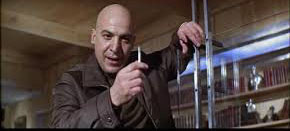
As Blofeld, Telly Savalas acquits himself well. It’s true that he looks nothing like the Blofeld we encountered in You Only Live Twice, but if recasting characters is a problem for you, I dunno what you’re doing watching this franchise. His Blofeld is far more hands-on than the other incarnations, often leading his men in the field. His trademark white cat is absent though. Maybe it didn’t like the cold? I am glad they didn’t use Donald Pleasence in this film. Not that I have anything against the late actor. I just couldn’t buy his Blofeld fighting Bond on a runaway bobsled, let alone almost getting the better of him in that fight. Savalas brings both a needed physicality and oily charm to the role, which suits the film. My only problem with him is that he has an awfully strange way of holding a cigarette. Take a look at this picture to see what I mean.
The only other villain of note is Blofeld’s henchwoman, Irma Bunt. She’s not counted as a Bond Girl because there’s never any suggestion of an attraction between her and Bond. But she is very notable because of her role in the film. It is her, not Blofeld, who kills Tracy at the end of the film. I’ve seen many articles where the writer erroneously pins the crime on Blofeld, but all he was doing was driving the car when it happened. Bunt was the trigger-woman, and the amazing thing is, she got away with it! Bond never gets his revenge on her in any other film (Actress Ilse Steppat passed away soon after the film was released. An early draft of the script for the next Bond movie would have seen the spy chasing her to her death in the London Underground. However, the actress’ death and Lazenby’s departure from the series nixed that story idea.)
And then we have Tracy Bond, who, if you’ve read what I’ve had to say about her thus far, you know I hold in high regard. The screenwriters improve on the Tracy from the source novel by having her be a stronger and more intelligent character. I don’t blame Bond for falling in love and marrying her. If she had been just another Bond Girl, who he seduces and then forgets by the time the next film starts, I think the film wouldn’t work as well as it does. Diana Rigg owns the role. When, in an early scene, she tells her father to give Bond the information he wants or Draco will never see her again, Rigg nails the delivery. There’s no doubt in my mind that Tracy means it. She grounds every scene she shares with Lazenby and, with all apologies to the rest of the excellent cast, is the best performer in this film. You just can’t take your eyes off of her, and that has nothing to do wit her looks (Not that there’s any flaw on that front either.)
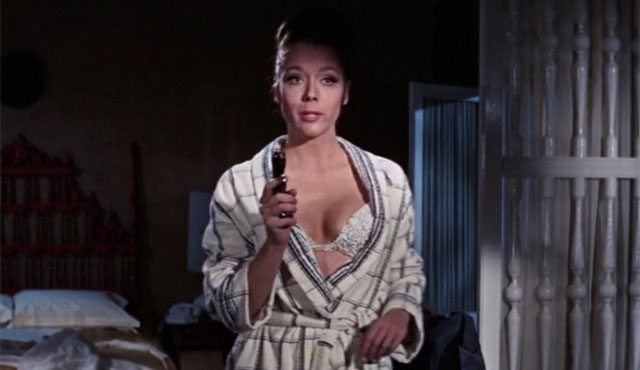
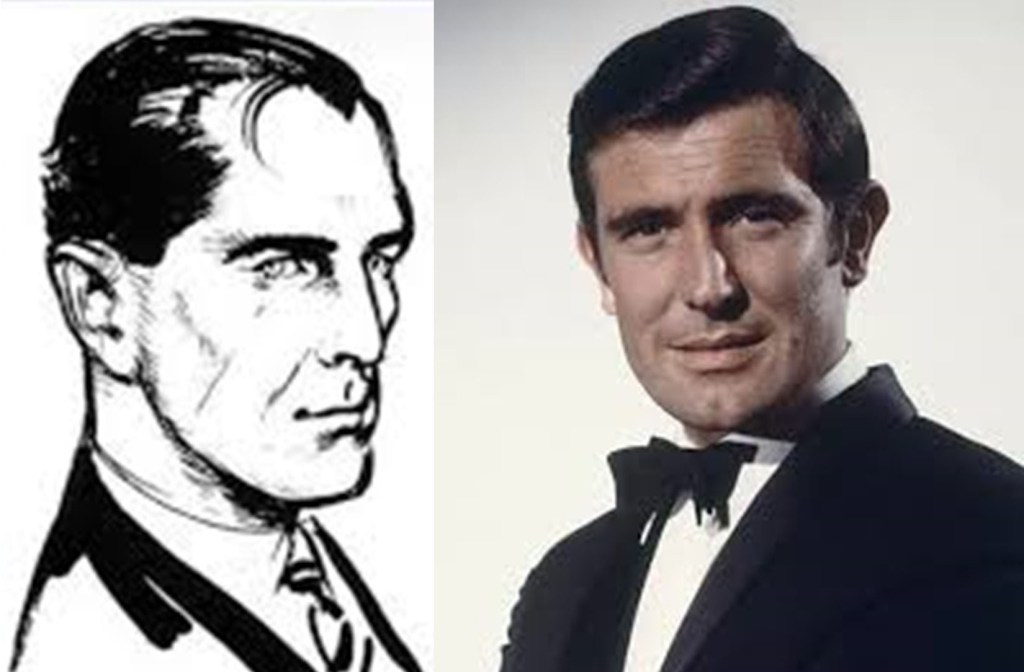
Which brings us back to Lazenby. As I said at the beginning, he’s not my favourite Bond. I don’t think he’s anybody’s favourite in the role. But I find he’s fine. He doesn’t distract me from the plot. Not even when he’s posing as Hillary Bray. He looks great in the action scenes and I never question his presence in the other parts of the film. He might seem a little nonchalant at times, but I grew up on Roger Moore’s Bond so I’m used to nonchalant. And I do wanna mention that, of all Bond actors, including the ones from 1954’s and 1967’s takes on Casino Royale, Lazenby is the one who most looks like Bond. Bond creator Ian Fleming once sketched the character and I think Lazenby is the one who most closely resembles the sketch.
Lazenby and the movie go hand-in-hand as the great ‘What Ifs” of the Bond series. What if he’d decided to accept the 7-picture deal EON had offered him? Would he have grown into the role? Would his career have blossomed instead of cratering out? What would the next Bond films have looked like instead? Would the next film in the series have picked up the plot threads this film had left and stayed a down-to-Earth thriller instead of a fanciful romp? Would Tracy’s death be used as a jumping-off point to lean the series into a tighter continuity with a harder-edged protagonist, like the Daniel Craig-fronted films turned out decades later?
We’ll never know. All we can do is watch this film, and this take on Bond, as it is. It’s an exciting and engaging story, well-told with a downbeat ending. But as the Bond theme playing at the end of the film assures us, Bond would return. Two years later, wearing a very familiar face.
Final verdict:
P.S.: I spoke of the plot hole in this film wherein Blofeld, who has met Bond before, doesn’t seem to recognize him when he meets him again. If this plot error really, really bothers you, here’s a couple of fan theories I found online that explains why the villain fails to spot the agent. See if either one strikes your fancy.
- The following film in the series will show us that Blofeld is fond of using body doubles. So the man who meets Bond here is not the real Blofeld but just a body double who’s never encountered Bond before. This also explains why this Blofeld has an American accent.
- In the previous film, Blofeld had a facial scar over one eye and didn’t blink much. This indicates the character had vision problems. So when they met in S.P.E.C.T.R.E.’s volcano lair, Blofeld didn’t actually get a good look at Bond because of his poor vision. In between films, the villain got surgery to change his appearance and fix his defective eyesight. And it also somehow made him taller. Sure, why not?
 Dr. Gorgo's Den
Leave a comment