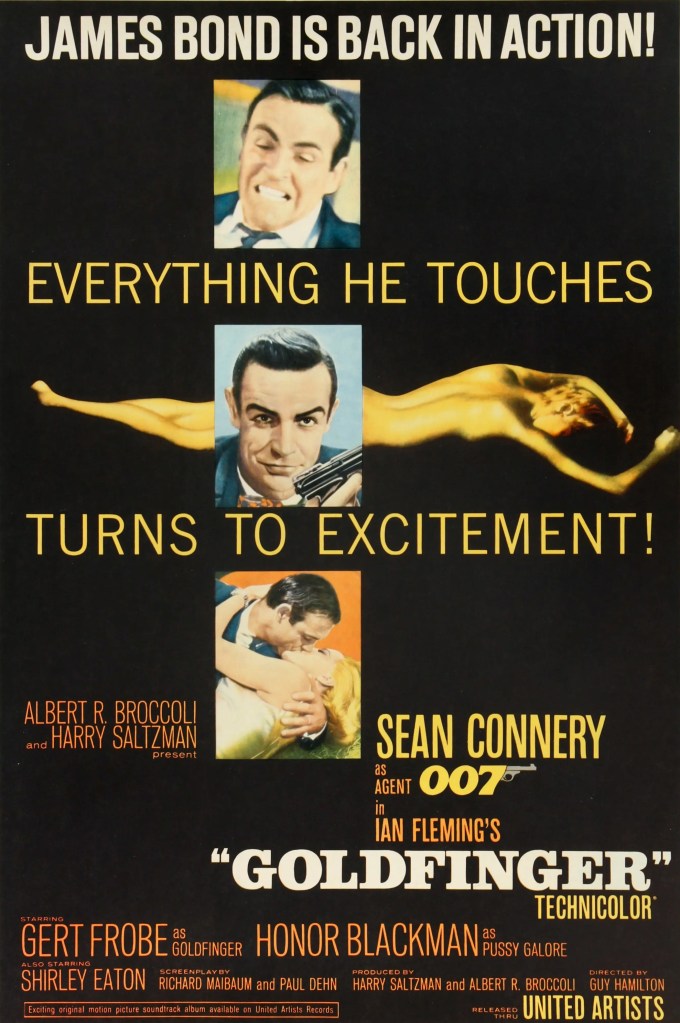
II saw my first Bond film in theatres, Moonraker, back in 1979. However, I had seen other Bond movies when they aired on television. I really liked them, so I was quite familiar with Bond and his adventures by the time I saw him on the big screen. I hadn’t yet seen all the preceding Bond films, but I’d probably seen most. And as I began to read fan magazines and opinion pieces on the film series, one thing became clear: Everybody thought Goldfinger was the best Bond film.
Looking back, I can see why people thought that. In my previous review (See FROM RUSSIA WITH LOVE), I mentioned that if you prefer Goldfinger over From Russia With Love, you probably preferred the more fanciful Bond films. Well, in 1979, Roger Moore was midway through his 7-film tenure as the super-spy and the fanciful flavour was very much in vogue.
But then a funny thing happened. People began not to rate Goldfinger as highly. Part of that was simply that some of the later entries in the film series were really great and settled into higher spots on many viewers’ rankings. The other issue was that Timothy Dalton and Daniel Craig both had stints in the role where the films got grittier, so the goofier Bond films weren’t in fashion anymore.
So while that’s why Goldfinger isn’t the consensus top-ranked film anymore, don’t let that fool you because this is still a very good film. It adds the last three missing ingredients to the Bond film formula. Q’s exasperation with Bond’s cavalier attitude towards his equipment (an idea of director Guy Hamilton) starts here, as does the tradition of female characters with outrageous names. Seriously, Mr. and Mrs. Galore, why did you saddle your daughter with the first name “Pussy”? Did you think she was going to get an office job with a name like that?
The final missing ingredient is the appearance of an independent villain. It’s a bit of an anomaly at this point in the series, as this film is the only one of the first seven which has nothing whatsoever to do with S.P.E.C.T.R.E. The EON producers were loath to use the organization again because the film rights to it and it’s leader, Ernst Stavro Blofeld, were in dispute at the time. (In case you don’t know, EON Productions would produce 25 of the 28 Bond films you’ll read about in my reviews. The EON films are the “official” Bond films while the other three, Casino Royale (1954), Casino Royale (1967) and Never Say Never Again, are “unofficial” Bond films), Anyway, the production company decided to make the villain Goldfinger an independent operator as opposed to an agent of SMERSH, as he was in the book.
It’s a minor change that doesn’t really take anything away from the story. Indeed, I’d say the idea of this villain comming up with and executing this scheme mostly on his own makes him a better and more important villain in the Bond mythos. Another important change for the better occurs early in the film when Bond finds Jill Masterson dead in his hotel room. In the book, she is still killed by being covered in gold paint and suffering skin suffocation, but after Bond has left Miami. He only finds out about it from her sister Tilly. Here, he finds her dead body himself. It’s much more dramatic and the image of Jill covered in gold paint on the mattress of her room is one of the most iconic of not only the series but of 1960s cinema in general.
And just to make it clear, covering someone with gold paint will not lead to their demise. You probably still shouldn’t do it though.
Before we get there though, there’s the pre-credits scene where Bond infiltrates a drug processing plant and sticks explosives all over it. Then, his work done, he removes his wetsuit and reveals he’s wearing a tuxedo underneath it. In the previous two Bond films, there were some strange moments and gadgets. An attaché case full of surprises? Okay. Poison-tipped blades hidden in people’s shoes? I guess. But a man wearing a white tixedo under a black wetsuit is where, I think, the series steered itself into unbelievable territory.
So after he makes his way to a nightclub and the explosives destroy the lab, Bond kisses a local dancer and then kills a goon who attacks him. He does so by electrocuting him, and this will not be the last time he offs somebody that way in this movie. After frying the guy, he delivers one of my favourite quips in the entire series when he observes, “Shocking! Positively shocking!”
We then get one of the series’ most iconic theme songs. I don’t normally talk about the music in these films much. It’s too subjective a subject, in that either the music strikes your fancy or it doesn’t. But in this case, I must point out that the singer, Shirley Bassey, is the only one to sing more than one Bond theme song (she’ll return to sing the title songs in Diamonds Are Forever and Moonraker). So when I say she’s the iconic Bond singer, it’s not my opinion, it’s the numbers that back up that statement.
After the credits and the song end, we are taken to Miami where Felix Leiter finds Bond getting a massage poolside at his hotel. Here Leiter is played by Cec Linder because Jack Lord, who played Leiter in Dr. No, supposedly wanted too much money and equal billing with Sean Connery. Bond’s masseuse, Dink, is played by Margaret Nolan. Nolan is also the gold-covered woman we saw in the film’s opening credits. Before Leiter briefs Bond on his latest assignment, Bond ushers Dink off by telling her he and Felix must have “man talk”. And then he gives her a slap on the ass to get her moving. I know this movie was made in a different era, but I still find the sexism on display here a little uncomfortable. Unfortunately, things will get worse later on.
Leiter lets Bond know his new assignment is to observe one Auric Goldfinger, who happens to be sitting nearby, cheating at a game of gin rummy. The spy figures out that the rogue’s getting help by someone observing Goldfinger’s opponent from the villain’s suite in the hotel. So Bond goes up there to find Goldfinger’s accomplice is a beautiful and scantily-clad blonde named Jill Masterson. Bond threatens to expose Goldfinger to the local authorities unless he starts to lose at his game. Then Bond and Masterson retire to Bond’s room. After some cavorting there, Bond gets knocked out by a mysterious assailant and wakes up to find Jill dead on his bed, painted in gold.
We figure out later that it was Goldfinger’s henchman Oddjob who knocked out Bond. It’s never explained how Goldfinger tracked Masterson to Bond’s room, but I’m not ready to call this a plot hole. Bond gently coerced a hotel maid to let him into Goldfinger’s room, so it’s not unreasonable to assume she reported it to someone and the information eventually reached Goldfinger. But a throwaway line in a later encounter between the two might have cleared the question up.
Bond returns to England where he’s given more information on the villain. He’s on MI6’s radar because he’s smuggling gold. Bit of a step down, ambition-wise, from the previous two films’ baddies, but don’t worry, he’ll come into his own real soon. Then Q shows off a few gadgets and introduces Bond to the Aston Martin DB5, the car that will most become associated with the character. I used the word “Iconic” a few times earlier in this review and I’ll use it again before I’m finished it. But when discussing the DB5, no other word describes it as well. One of the reasons I love the 007 series is that it’s timeless. You can watch one of the films and imagine that that, somewhere, right now, the world looks like what you’re seeing. The DB5 is a great car for that. It looked great then, and it looks great now. As a matter of fact, All subsequent Bond actors would drive an Aston Martin at some point and in the case of three of them, it was this model in particular (although Roger Moore’s turn behind the wheel of a DB5 would be in The Cannonball Run, which is not a film in this series).
Now briefed and equipped, Bond meets Goldfinger at a golf club and it is here where we’re introduced to the henchman, Oddjob. Silent, menacing, a great shot with his lead-brimmed hat and capable of crushing a golf ball in his bare hands, the hulking Korean is one of the best henchmen in the entire series. I’ve seen lists of the best villain/henchman combos of the movies and these two are always at or near the top. If you ask me, Oddjob’s the one doing the heavy lifting in that competition.
After the golf game, Bond trails Goldfinger by car through Switzerland for a while and runs across the second major Bond Girl of the film, Tilly. Although we don’t find this out until a little later in the film, she’s the sister of the unfortunate Jill Masterson from the earlier Miami scenes. Like Bond, she’s tracking Goldfinger, out for revenge, though she’s not particularly good at getting it. When Bond is skulking around Goldfinger’s factory, he overhears the villain mention “Operation Grand Slam”. Before he can find out more, he spots Tilly and she trips an alarm. Bond tries to escape with her by using his car’s gadgets but fails. Tilly is killed by Oddjob’s deadly hat and Bond is captured.
Tilly’s death is a bit of a departure from the book, as she’s not killed until much later in the book’s story. But I think the screenwriters made a good call here. It’s not actor Tania Mallet’s fault, but Tilly just isn’t much of a fun character to watch. She’s a terrible liar, a crappy markswoman and has no chemistry with Bond (though, honestly, she’s not really supposed to). Her extended presence doesn’t really do the book any favours so I’m not sad the film gets rid of her so quickly.
Bond wakes up strapped to a gold slab and with Goldfinger firing up an industrial laser that’s slowly inching it’s way towards the spy’s crotch. This is an iconic scene, one of the highlights of the entire series. There are a lot of good dialogue exchanges here, and I won’t start listing them or else this review will double in size. In the end, Bond manages to bluff Goldfinger into letting him live by making him believe he and his superiors know more about “Operation Grand Slam” than he really does.
Bond is knocked out again (Third time in the movie. He’s gonna get brain damage at this rate) and wakes up on a private jet on its way to the United States. It’s here that we meet Pussy Galore, who’s Goldfinger’s private pilot. In the book, she was the leader of a gang of female cat burglars and also a lesbian (until the end of the book anyway, thanks to Bond’s irresistible charm). In this film though, it’s never specifically stated. She simply states that she’s immune to Bond’s charms and she wears pants, so, draw your own conclusions. Incidentally, Pussy is played by Honor Blackman, who had previously starred on the British spy show The Avengers. Three more of that show’s stars will appear in Bond films as the series goes on (Four if you count the show’s 1998 cinematic adaptation, which was terrible).
There’s not much that happens on the plane except that Bond surreptitiously activates a small tracking device in his shoe and warns Pussy that firing a gun inside an airplane can be very dangerous, thus foreshadowing the film’s climax. There is a throwaway exchange where a Korean flight attendant informs Bond that his luggage is aboard but that his attaché case was destroyed while being examined. I take this to be a reference to the same sort of case he used in From Russia With Love and that Goldfinger’s people activated the tear gas bomb it contained. It’s a cute bit of continuity from a film series that often doesn’t have any.
Now, so far, this has been a top-notch Bond film. Perhaps, even, one of the best of the entire series. You might expect I’ll be giving it a four-martini review. Unfortunately, from here on in, the film starts to go off the rails.
Bond is taken to Goldfinger’s stud ranch (stud horses, that is. No, Bond is not being made to sleep with various ladies under duress). Felix Leiter is tracking Bond and keeps him under surveillance. The ranch is in Kentucky, and Goldfinger’s plan involves attacking the U.S. gold reserve at nearby Fort Knox. So, story-wise, the location makes sense. However, compared to Jamaica and Istanbul, where all the action took place in the last two movies, Kentucky really doesn’t jump out and grab me as an exotic destination. And it’s not like the film had to have Goldfinger plan the heist near the fort. In the book, he plans everything from New York City. Maybe not a city that needs more on-screen exposure, but definitely a more exciting place than Kentucky.
So Bond is stashed away in Goldfinger’s basement and then the film just stops making sense for the next ten minutes. Bond escapes, which I have no problem with, but then he eavesdrops on a meeting Goldfinger has with a bunch of mobsters. He’s promised them each a million dollars (in gold, naturally) for their efforts in smuggling his equipment and workforce into the country. He then lays out his bold plan to break into Fort Knox and steal the entire American gold reserve after having unleashed “Delta-9” gas on the area. Then Bond is found and captured again. Meanwhile, the mobsters express their interest in Goldfinger’s plan. All save for a Mr. Solo, who want’s no part in it.
Bond is taken outside where he encounters Goldfinger and Solo overseeing a million dollars in gold being loaded into a car. Bond slips his tracker and a note detailing Goldfinger’s plan into Solo’s coat without anyone noticing. He hopes that Leiter will apprehend Solo and find the note. But Oddjob drives Solo to a junkyard and shoots him dead before getting out of the car and letting it get placed into a crusher. Meanwhile, back at the ranch, the rest of the gangsters are all gassed and killed.
At this point, I have a lot of questions. Why didn’t Oddjob take the gold out of the car before it got loaded into the crusher? Or better yet, why not just throw Solo’s body into a different car, crush that one and just drive the original car and the gold back to the ranch? For that matter, since Goldfinger was gonna kill all the mobsters anyway, why did he bother laying out his plan to them? They were all waiting for him to show up in his recreation room, including Solo, so why not just gas ‘em all early? Especially since his plan to steal the gold was all a fabrication anyway? They’d already served their purpose in his real plan, so why tell them anything at all?
Said real plan is not to steal any of the gold at the reserve but to irradiate it with a nuclear device thus making it inaccessible for 58 years and increasing the value of the villain’s gold holdings substantially. The Chinese, who have supplied the device, look forward to seeing the U.S. economy collapse. It’s a little odd that the producers of the Bond series avoided making the Soviets enemies in the films, but had no trouble making the Chinese bad guys instead. What I like about this scene is that Goldfinger doesn’t explain much of his plan. It’s more a case of Bond figuring it out himself and the villain simply supplying some details here and there.
I should point out that in the book, Goldfinger did actually plan on stealing the gold. But the film producers decided the idea was too impractical and changed the villain’s plan. Some financial reporters at the time complemented the film for having a more realistic plot than the book’s, which was probably the last time the words “realistic” and “Bond film” were ever used in the same sentence.
The next scene is the one I have the most problems with. Seeing that the CIA agents are still keeping a long-range eye on Bond, Goldfinger asks Pussy to hang out with him to make sure the agents think he’s fine. She and Bond talk and end up in a barn where he tries to seduce her. She responds with judo throws and the two have a very light exchange of trips and falls. It ends with Bond forcing a kiss on Pussy. She tries to fight him off, but eventually is won over. There’s no nice way to say this, but the fact is, this scene is creepy as fuck. I know it was made over sixty years ago but sweet Jesus do I feel uncomfortable watching James Bond pretty much force himself on a woman!
We then proceed to witness the assault on Fort Knox. First, Pussy’s team of sexy female pilots (because of course they’re sexy) fly over the base and gas everybody. Then, Goldfinger’s men use the laser from earlier in the film to cut open the reinforced doors to the gold reserve. Once that’s done, Pussy and Goldfinger arrive by helicopter with the nuclear device, It is wheeled inside the main vault with Bond handcuffed to it. But then Leiter and the troops, who had not been killed by the gas (presumably because Pussy, now smitten with Bond, had replaced it with something else before her pilots took off that day) stop playing possum and attack Goldfinger’s men.
As the battle commences, Goldfinger escapes with Pussy, but not before sealing the inner vault, trapping Bond, Oddjob and another henchman inside. The henchman starts to panic, so Oddjob throws him off an elevated platform. He lands next to Bond, who retrieves the handcuff keys from his body. Now freed, the spy is forced to fight Oddjob. It’s a very one-sided affair, with the Korean handling his opponent easily. But in the end, Bond manages to electrocute the brute (the second time he kills someone that way in this film). Bond makes his way to the nuke but it’s Leiter and his men who manage to deactivate it with seconds to spare.
With the day saved, Bond is put on a private jet to go meet the president. But once in the air, Goldfinger steps out of the cockpit where he’s been waiting with Pussy. He’s aware she betrayed him but still brought her along because I assume he doesn’t know any other pilots. He threatens Bond with his gold gun (you gotta love a villain who can stick to his theme) and when the two struggle, it goes off and blows out a window. The entire cabin depressurises and Goldfinger is sucked out to his death. Bond makes his way to the cockpit where he and Pussy try to straighten out the plane, to no avail. It crashes into the ocean, but Bond and Pussy are seen making out under the parachute they escaped the plane with. This, incidentally is the only Connery Bond film to end with Bond and his lady not in a boat or a pool. Sean Connery’s Bond just seems to get randy around water.
All in all, this is an enjoyable film and it has many iconic moments and images in its first half. Goldfinger is a decent villain and Oddjob an outstanding henchman. Incidentally, Goldfinger actor Gert Frobe didn’t speak his lines in English but in his native German. He was dubbed by actor Michael Collins and it’s really hard to notice. I commend the filmmakers on that, but the nonsense with the gangsters and the uncomfortable sexist scenes, including the sickening scene of Bond seducing/assaulting Pussy Galore knock the film down a notch for me.
Final verdict:
 Dr. Gorgo's Den
Leave a comment