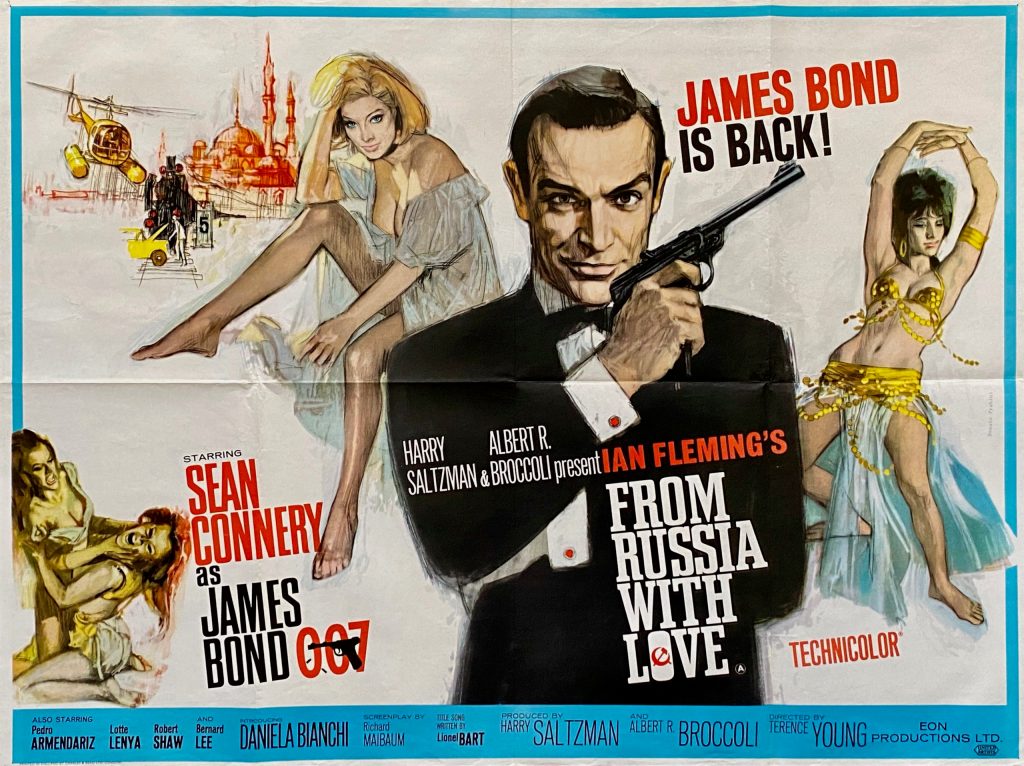
Among fans of the Bond films, there’s a lot of disagreement as to which is the best of them. Normally, I wouldn’t wade into that sort of debate. However, I will mention this: In an interview I read with longtime Bond producers Barbara Broccoli and Michael G. Wilson, one of them said that when they start production on a new Bond film, their goal is to make another From Russia With Love. So if that’s the bar as far as they’re concerned, who am I to argue?
Now, some fans may decide that they wanna argue, and that’s fine. That’s why these reviews have a comment section. However, one thing that most fans agree on is that if you’re just discovering the Bond franchise, you might wanna take this test: Start by watching From Russia With Love and then its follow-up, Goldfinger. They’re both good films, and you can certainly like them both. But if you prefer From Russia With Love, then you’ll probably be a fan of the more grounded and slightly more realistic Bond films, while if you prefer Goldfinger, you’ll probably prefer the ones that are somewhat more fanciful.
I might as well tell you, at this point, that I much prefer From Russia With Love. So going forward, you’ll understand from where my opinions and rankings are coming from. As a matter of fact, save for one film I like better, this one is my favourite of the entire series. Of all the films in this run about a spy, it’s possibly the one who’s plot is all about actual espionage work. Bond is sent to help a Soviet cypher clerk defect to the West so that she can hand the British a machine that can decode intercepted transmissions. Short of a movie about a spy infiltrating an enemy headquarters building, I don’t think you can get any more espionage-y in your plot.
Having successfully introduced us to Bond in Dr. No, this film allows itself to take the early focus away from him and introduce us in earnest to S.P.E.C.T.R.E., the villainous organization that Bond will tangle with for five of the next six films. Doctor No had mentioned he worked for them in the previous film, but this is the movie where we really get a sense of what S.P.E.C.T.R.E. is all about. Their plot is to get the clerk to give the machine to Bond and then S.P.E.C.T.R.E. can kill Bond to get their hands on the machine and sell it to the highest bidder.
Before I forget to mention it, this film features the first pre-title credits sequence of the series, one of its signature features. In it, we see a menacing assassin stalk and strangle Bond with a garotte. However, it’s revealed the dead man isn’t Bond when S.P.E.C.T.R.E.’s head trainer removes the dead man’s facemask, revealing him to be some other guy. The mask’s removal is accompanied by a sound thet seems to be a piece of raw meat being torn in half. The foley artist (sound effects technician) was really swinging for the fences with that one.
It’s also in this film that we’re first introduced to S.P.E.C.T.R.E.’s leader, Ernst Stavro Blofeld. We never see his face, and his name is never uttered. In the credits, however, his name is listed and the actor playing him is credited as “?”. Cute, but I know who played him. Anthony Dawson, who played the treacherous Professor Dent in Dr. No, was Blofeld’s hands and body while his voice was provided by German character actor Eric Pohlmann. The duo also returned when the character did in Thunderball two years later.
In the novels, S.P.E.C.T.R.E. only appears in three books and the one this film is based on isn’t one of them. In the first half of his literary adventures, the enemy was usually SMERSH, a Soviet counter-intelligence agency. But Bond film producers Albert Broccoli and Harry Saltzman didn’t want to make Russians the villains because the producers predicted that eventually, tensions between the Soviets and the West would ease. Considering they were working on this film when the Cuban Missile Crisis was going on, I’d say those two were very forward-thinkers. But this is why the film series leaned more on S.P.E.C.T.R.E. during the 1960s before turning to independent villains thereafter.
Considering S.P.R.C.T.R.E. wasn’t part of the original narrative, the agency slots into the film’s plot rather neatly. They use the beautiful cypher clerk Tatiana Romanova to bait the trap for the British and more specifically, Bond. They trick her by employing Col. Rosa Klebb, a S.P.E.C.T.R.E. agent who very recently defected from the Soviet Union, so Romanova won’t be aware of her true affiliation. Klebb recruits Donald “Red” Grant (the assassin from the opening sequence) to be her operative in the field. Grant makes sure to stir things up between the Soviet and British spy agencies in order to make the whole operation appear more legitimate. This is all good, interesting stuff.
I gotta say that I’m hard pressed to think of a better villain/henchman pairing* in this entire series than Klebb and Grant. Klebb is cruel, efficient and a touch sadistic while Grant is the first example of what some call “Shadow-Bonds”, characters who have similar roles or skillsets to Bond, but are evil.
* = There are some Bond fans who don’t consider Klebb the villain of this film because she is clearly subordinate to (and afraid of) Blofeld. However, since he never confronts Bond and she does (in the film’s climax, no less), I’m giving her the nod. I’ll do the same when Blofeld also fails to confront Bond in Thunderball. Besides, if Klebb’s a henchwoman, and Grant is is her subordinate, what does that make him? A sub-henchman? Forget it, I’m not dealing with that can of worms. Klebb’s a villain and Grant’s a henchman and that’s that!
Anyway, Bond is once again briefed by M on his mission. The scene is notable as it features the first appearance of Desmond Llewelyn as Q (but listed in the credits as “Boothroyd”. See DR. NO for my thoughts on that character). He gives Bond the first gadget we’ll see in the official series, an attaché case. I like that it’s got multiple concealed knick-knacks in it (sniper rifle, throwing knives, tear gas bomb, gold coins, spare ammo) and he doesn’t end up using all of them in the film. As a matter of fact, the knives don’t get used, which is amusing because in the book, the attaché case also appears and the knives end up being the only feature Bond uses.
Bond flies to Istanbul and meets MI6’s section chief of Turkey, Kerim Bey, played by Pedro Armendáriz in his final role before his death. Bey is a delightful character who assures his operatives are loyal by trusting most of his missions to his sons. He and Bond strike up a friendship very quickly but if you’re helping Bond in the first act of a movie, chances are you’ll be killed before its end.
But in the meantime, Bond and Bey discuss the mission, the Soviet opposition and how to get Romanova out of town. Bond meets her when she sneaks into his hotel room and climbs into his bed, nude. Because of course she does. The Bond producers liked this scene so much, they had actors later auditioning for Bond or his leading lady act out the scene to get a sense of if they were right for the series. If you look at the special features of more recent Bond media, you can often find footage of these auditions with actors such as James Brolin, Sam Neill and two-time Bond Girl Maud Adams.
Bond and Bey also visit a gypsy camp where a firefight with Soviet agents takes place and Grant, hiding in the shadows, kills a goon that was about to kill Bond. Though the plot of the film follows the book rather closely, this detail is an invention of the screenwriters. I do like how S.P.E.C.T.R.E. is keeping Bond alive because he hasn’t finished playing his part in their scheme yet.
There’s some more business with Bond helping Bey kill the Soviet agent who led the attack on the gypsies before Bey’s men (presumably more of his sons) place a mine under the Soviet embassy. When it goes off, Bond uses the confusion to spirit Romanova and the Lektor machine to the train station where they board the Orient Express. However, they’re spotted by a Soviet Commissar, Benz, who jumps on as the train is leaving. The plan is that the train will stop in a few hours, Bond and Romanova will quickly jump off and another of Bey’s sons will drive the two to a private airstrip where they’ll take off for England. So Bey says he’s made arrangements for the train to stop with the conductor and then he and Bond go manhandle Benz. Bey says he’ll babysit the guy until the train stops so Bond leaves him to it.
Unfortunately, Grant is also on the train and while we don’t see him do it, he kills both Bey and Benz, making it appear like they killed each other. The conductor alerts Bond to this and when the train arrives at the spot where Bey’s son is waiting to pick up Bond and Romanova, it doesn’t stop. Why not? According to Bey, he’d already made the arrangements.
Whatever the reason is, the train goes onto Belgrade where Bey’s son is waiting for Bond. Presumably, the escape plan is blown as he and Romanova don’t simply drive away to the airstrip mentioned earlier. But Grant overhears Bond ask for a British operative to meet him at Zagreb with an escape plan. When the train gets there, Grant gets off first, intercepts Nash, the British agent and takes his place, using the subterfuge to get close to Bond.
At this point, I have to ask, was all of this necessary? If Grant could get close enough to Bey to somehow murder both him and Benz in a way that covered up his presence, couldn’t he have gotten close enough to Bond earlier to kill both him and Romanova and then simply make off with the Lektor?
But for whatever reason, Grant pretends to be Nash, sent to help Bond escape. At dinner, he drugs Romanova to get her out of the way and reveals the escape plan (which is his own plan devised by S.P.E.C.T.R.E.) to Bond before turning on him and holding him at gunpoint. Bond tricks Grant into opening his attaché case, triggering the tear gas bomb. Bond and Grant proceed to have a fairly brutal fight in the close confines of the train car that Bond wins, killing Grant.
It is at this point that the film leaves the novel behind as Bond and Romanova jump off the train as it slows down to navigate a sharp turn and they take the truck of the S.P.E.C.T.R.E. agent who was to meet Grant. As dawn breaks, a helicopter arrives and tries to stop Bond by dropping hand grenades on him. Is this really the best way to recover the Lektor undamaged? Anyway, the scene, which owes a heavy debt to the crop duster sequence in Alfred Hitchcock’s North by Northwest, ends when Bond uses his sniper rifle on the guy lobbing grenades, Then Bond and Romanova steal a boat on the Yugoslav coast that they plan on riding all the way to Italy. They are ambushed by some S.P.E.C.T.R.E. boats but Bond manages to get rid of them by blowing up some gasoline barrels near them with a flare gun.
Klebb is ordered to go get the Lektor and kill Bond. She sneaks into his hotel room disguised as a maid and holds him at gunpoint. She orders Romanova away but the clerk returns and tackles Klebb, knocking the gun to the floor. Klebb attacks Bond with a poisoned blade concealed in her shoe while Bond holds her off with a chair. I think it’s supposed to be a suspenseful sequence, but honestly, when I rewatched the film with some friends recently, they laughed at the sight of Bond taking on a diminutive shoe-wielder. Romanova ends up shooting Klebb. And then we cut to Bond making out with Romanova on a gondola in the canals of Venice before the credits roll.
A few plot inconsistencies aside, I really love this film. Some people think the gypsy camp sequence is unnecessary, but I quite like it when the Bond films act as a travelogue, giving us glimpses into cultures different than our own. I think Kerim Bey is one of the most entertaining Bond allies in the entire series. I’ve already said I think the Klebb/Grant duo is the best villain/henchman pairing in the entire series (Sorry Goldfinger/Oddjob). And the plot and screenplay are probably the best in the series. Everybody here turns in a good performance, with Connery, Armendáriz and Robert Shaw as Grant being standouts.
The only issue I have with the film is the character of Tatiana Romanova. She’s very integral to the plot in the film’s first half. I can even excuse some f her more lovey-dovey dialogue because she’s been ordered to act like she’s in love with Bond, so that explains why she’s maybe laying it on a little thick. But once she and Bond get on the train, she becomes more or less useless for the second half of the film. I understand the need to have her drugged to get her out of the way for the big Bond/Grant fight, but her grogginess in subsequent scenes annoys me. There’s being a damsel in distress and there’s being an annoying hindrance, and I think she’s close to becoming the latter for a while there. Couldn’t they just have her say the fresh air after she got off the train cleared her head?
But this is a very minor problem in an otherwise outstanding film.
Final verdict:
 Dr. Gorgo's Den
Leave a comment