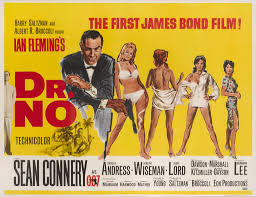
Can we please give some love to Sylvia Trench? She’s one of the most important of all the Bond Girls.* Not only is she one of only two Bond Girls to appear in multiple films (Three if you count Moneypenny, four if you count Judy Dench’s M, both of which I don’t), but she sets up the most important line in the entire Bond franchise. While playing baccarat with her at a casino, Bond, whose face we’ve yet to see at this point, tells her, “I admire your courage, Miss…?” When she replies, “Trench. Sylvia Trench. I admire your luck, Mr…?”, he answers, “Bond. James Bond.” And thus, a legend is born.
* = I am aware that the term “Bond Girl” sounds pretty sexist in our modern parlance. I will use it throughout these retrospectives simply because that’s how these women were referred to in the media for decades. Don’t let my usage of the term make you think I hold these characters in low esteem. I’ll only do so if they’re used as a pretty face and little else so far as the movie’s plot is concerned.)
It is only when Bond delivers his iconic line that we get to see his face. In the moments leading up to the reveal, all we saw was his hands and all we heard was his voice. And suddenly, there his is, calm, cool, dangerous and, yeah, I’ll say it, sexy as all Hell. It may not be the greatest introduction of a character in film history (I’ll still give the nod to Harry Lime in The Third Man), but it’s certainly in the top five.
In many ways, the film mirrors its protagonist. It’s about as confident a piece of filmmaking as you’re ever likely to encounter. Sean Connery is in almost every scene in the film and the producers knew they had something with this guy. They were confident that, by just putting him centre-frame and letting the scene unfold, the audience would be mesmerized, and they were right! While the plot moves things along at a good pace, what’s happening is made all the more interesting because of the man at its centre. The action sequences would get more grand and more elaborate as the films went on, so much so that you might not be too impressed with the action in this one. And that’s fine. This film is more of an espionage film than an action one, and subsequent ones would bounce between the two extremes. But Bond himself would stay pretty constant (barring actor changes, of course).
After a false start with the character’s first adaptation (see CASINO ROYALE (1954)), Bond arrives here fully-formed. This is the super-spy we’re going to get to know for the next sixty years. To be fair, when first adapted, Bond was the star of a mere two books, while by the time Dr. No started shooting, the book series was into it’s seventh novel. Therefore, Bond’s identity was much more firmly established by that point. Connery plays him as a cool, professional agent with a dangerous edge and a way with a quip. (An invention of the screenwriters here. In the books, Bond doesn’t quip much) It’s amusing to note that Bond author Ian Fleming originally disapproved of Connery being cast as the spy, feeling the actor was too muscular and not sophisticated enough. However, after the film was released, Fleming was so impressed by Connery’s performance that he added Scottish heritage to the character’s backstory in later novels.
So after being introduced in the casino sequence and having a quick fling with Trench, Bond is summoned to a briefing with his boss, M. This is the first of many such scenes that will appear throughout the film series, and also introduces M’s secretary Moneypenny, with whom Bond will have an on-again, off-again flirtatious relationship. We are also introduced, in a roundabout way, to series mainstay Q, though you might not recognize him. Here, he is referred to as Major Boothroyd, MI6’s armourer, and played by Peter Burton instead of Desmond Llewelyn, who would play the character in subsequent films. For the next 15 years, the Bond producers denied Boothroyd and Q were the same character simply played by two different actors, before finally admitting it when they adapted The Spy Who Loved Me in 1977. I guess, since the series was on it’s third Bond actor by then, they figured the audience could handle some re-cast characters.
Bond is assigned to investigate the disappearance of the missing section chief in Jamaica. He travels there and is met by a local driver that Bond immediately figures out was not sent by his agency. After confronting the driver, who kills himself with a cyanide-laced cigarette, Bond knows something’s up. He investigates furthur and meets his CIA counterpart, Felix Leiter, here played by future Hawaii 5-0 star Jack Lord. The character will pop up in multiple subsequent Bond films, almost always played by a different actor. This is why it baffles me that the producers were alright with admitting that they recast Leiter but not Boothroyd/Q.
With the help of Leiter and local operative Quarrel, Bond continues his investigation, becoming suspicious of local geologist Professor Dent. In one of the few scenes in the film Bond’s not in, Dent travels to the island lair of the so-far unseen Dr. No, who gives him a tarantula to kill Bond with. The arachnid fails to do so, though the scene with it crawling on Bond’s chest is wonderfully tense. Yes, I know tarantula bites aren’t really that dangerous, but when I first saw this film, I thought the spider was lethal. Thanks for scaring the socks off of me, Bond franchise! Incidentally, the novel had Bond threatened by a Scolopendra centipede instead. They’re more dangerous, though their bites are only very rarely fatal. So, I guess I’m saying that if you’re getting your zoological knowledge from Bond movies or books, you might wanna take it with a grain of salt.
Bond, undeterred, continues sniffing around and this leads to my least favourite character in the film making her debut, Miss Taro. In the novel, she’s only mentioned once, in passing, and is described as being of dual Asian/Jamaican heritage. But here, her role is greatly expanded. She’s a secretary in the British consulate, passing on information to Dr. No and probably the one who alerted him Bond was coming to Jamaica. The problem is, the actor playing her, Zena Marshall, is a Caucasian woman with eye shadow supposed to suggest an Asian influence. This is not a look that has aged well. I know it’s sometimes pointless to look at old media and judge it with a modern eye. But considering this very same film series would be okay with Bond seducing Japanese women played by Japanese actors in You Only Live Twice a mere five years later, I feel my criticism of the casting here is valid.
After sleeping with Taro and then turning her over to the authorities (one of the few times in this series a villainous character doesn’t eventually get killed), Bond confronts Professor Dent, who had come to kill him but fired six bullets into a set of pillows Bond had set up on a mattress instead. He gives Bond a little info as his hand inches towards his revolver behind him. When he reaches it, he aims it at Bond but nothing happens because he’s out of ammo. Bond then calmly shoots him. Since the professor’s gun wasn’t loaded, you can’t call it self-defence, but instead, cold-blooded murder.
Bond and Quarrel then decide to sneak over to Dr. No’s island to investigate it and run into the other character everyone remembers from this movie, Honey Ryder, played by Ursula Andress. Andress made her English-speaking film debut in this movie (though her dialogue was dubbed by actress Nikki van der Zil, who would go on to dub several actresses in subsequent Bond films). Although a popular character that tops several lists of Best Bond Girls I’ve seen throughout the years, I must say I’m not as enamoured of Ryder as everyone else seems to be. Sure, she’s easy on the eyes, but I’m hard-pressed to think of a Bond Girl who’s as inessential to her film’s plot as this character is. She’s really only there to get looked at (a role she fulfils admirably) and for Bond to have someone to talk to after Quarrel gets killed.
Quarrel’s death, by the way, is a plot detail that I welcome. In the film’s early going, he seemed a knowledgeable and competent man. However, once he and Bond reach the island, he devolves into a superstitious yokel. Both he and Ryder believe the island is inhabited by a mysterious dragon that turns out to be nothing more than a tracked tank armed with a flamethrower. I can understand the fairy uneducated Honey Ryder being taken in by the deception, but the more sophisticated Quarrel really should have known better.
This is where the film really starts to embrace the tropes that we will see a lot in subsequent Bond films. Polite villain who has a nice dinner with Bond? Check. Villain explains his entire scheme to Bond? You bet. Villain’s Isolated base? Yes. Base blows up at the end? Affirmative. Gun barrel sequence at the film’s opening? Yep. Bond snuggling with a beautiful woman at the end? Of course.
But before we get to that end, Bond finally meets with the titular villain of the film. Like Taro was, He’s also played by a Caucasian actor, but this doesn’t bother me as much. The film doesn’t explain his backstory as much as the book does, but the character is only supposed to be half-Asian. And unlike what the filmmakers did with Miss Taro, the makeup effects on Dr. No do an adequate job of making him look neither Asian nor Caucasian but something convincingly different instead. I’ve seen some reviews knock the film because the Doctor only shows up in its final twenty minutes. I don’t mind too much. The earlier instance where we heard him speak to Dent, sight unseen, did a very good job of building up the villain’s menace. Especially how Dent looked positively terrified of him in that scene. So, we may not get a lot of the villain, but what little we do get works well.
After their dinner together, Bond refuses No’s offer to work with him. So, Bond is thrown into a cell, and less than a minute later, he’s managed to work his way into the base’s air ducts. The ease of Bond’s escape always bothered me. In the book, his access to the air ducts makes more sense as it’s part of a gauntlet No makes his prisoners run to test their endurance. Bond goes through the gauntlet’s challenges and manages to make it through to the end, when he emerges in the outside enclosure of a giant squid he fights and kills. This film, on the other hand, doesn’t feature any fight with a giant squid which, I think we can all agree, would have made it all the better if it had.
Instead, Bond sneaks into the power centre of the base and fights Dr. No to the death. It’s effective, but a part of me wishes they would have used the villain’s end from the book, where he’s crushed when Bond drops a ton of guano on him. They could even had Bond quip “Eat shit” when he did it. The quip writes itself! But anyway, with its power going haywire, the base blows up but not before Bond and Ryder wind up in a small motorboat. They make out, Leiter shows up in a submarine, the end.
As I said before, most of the elements we associate with a Bond film are present here. The only two missing from this film are that there is no pre-title credit sequence, nor are there really any gadgets in this film. These would be added in the next film.
But the main element here is Bond himself. He is very much the character we’d come to know and love right from the beginning. As a matter of fact, I saw the early films of the series out of order, which, thankfully, isn’t really a problem with Bond films. So, if you’re already familiar with Bond, you won‘t find anything different about the guy in this movie compared to the others.
So to sum up, this a good, efficient thriller and a great way to start the series. If you watch this film and don’t like it, I’d say the Bond films might not be for you.
Final verdict:
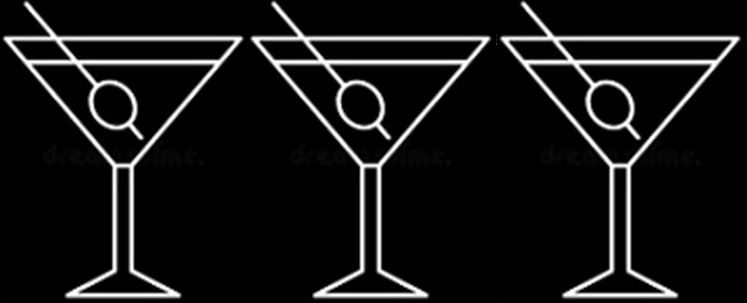
Would have gotten an extra martini glass if they’d thrown in either the giant squid or the guano kill. Had they thrown in both, this movie probably would have made more money than Avatar.
 Dr. Gorgo's Den
Leave a comment