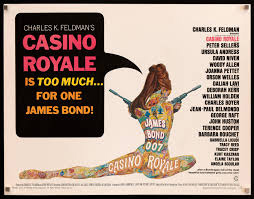
This film, like it’s 1954 namesake, is not part of the EON-produced official James Bond film series. Ian Fleming sold the film rights to his first Bond novel, “Casino Royale”, to producer Gregory Ratoff for $600 soon after its publication. A few months later, Ratoff took the story to the CBS television network who turned it into an episode of its “Climax!” television series (See CASINO ROYALE (1954) for more on that episode). After the episode aired, Ratoff paid another $6,000 to retain the rights in perpetuity. Whatever plans he had for the story never came to fruition as he died in 1960. His widow sold the rights to another producer, Charles K. Feldman, in 1961 for $75,000. A pretty tidy sum, and keep in mind that this was before Sean Connery’s series of films had even come out.
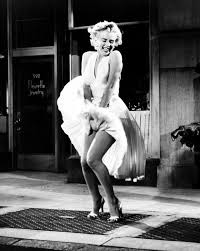
Feldman was a successful producer who had shepherded, amongst others, the classics A Streetcar Named Desire and The Seven Year Itch. The latter is the movie where the air from a subway grate blows up Marilyn Monroe’s dress. It’s become an iconic scene and image, so you might have seen it.
Bondmania really took off with the release of Goldfinger in 1964 and suddenly, Feldman found himself with the rights to make a movie about one of the most popular characters of the moment. Unfortunately, he knew he didn’t know how to make a movie that could rival the other Bond films that had come out, with their perilous stunts and exciting action sequences. He contacted EON productions heads Albert Broccoli and Harry Saltzman to try hammering out a deal to make a Casino Royale movie together. But the two sides could not work out an agreement so Feldman was left to his own devices. Instead of trying to beat EON at its own game, he decided he would spoof their Bond films instead.
Having just produced the successful What’s New Pussycat, Feldman re-assembled many of that film’s cast and crew, including Peter Sellers, Woody Allen and Peter O’Toole, though the latter only shows up in a quick cameo this time out. Feldman also recruited Dr. No’s Ursula Andress to play the main Bond Girl of the film. But a lot of the cast, especially Sellers, were under the impression that they were signing on to be in a serious Bond film, not a comedy. After the nature of the film was made apparent to him, Sellers brought in writer Terry Southern, with whom he’d worked on Dr. Strangelove or: How I Learned to Stop Worrying and Love the Bomb previously to re-write Sellers’ dialogue exclusively.
Sellers also feuded with Orson Wells, who had been cast as the villain Le Chiffre. Ironically, it was Sellers himself who suggested Wells be hired. But the two detested each other so much that the scene in which their characters play baccarat against each other was filmed with each delivering their lines to a body double when the other actor wasn’t there. Worse, Sellers held up the production to constantly go check on his new wife, Britt Ekland, who he was convinced was carrying on with other men when he wasn’t around. Eventually, his behavior angered everyone working on the film enough that Sellers was fired.
The problem was, Sellers had only filmed about thirty minutes worth of material. So the filmmakers had to come up with another ninety minutes’ worth of scenes featuring different characters and a Sellers-adjacent plot, all while production was already under way.
If you’ve read my other reviews of Bond films, you may have noticed that I focus more on the film itself and less on the behind-the-scenes stories. But I’m 600 words into this review and it’s been all behind-the-scenes stuff. I do this for two reasons. First and foremost, this just isn’t a very good movie, and the circumstances of its creation are far more interesting than the final product. Second, I think It’s important that you understand that this is an unbelievably schizophrenic film due in no small part to the chaos during its making. As I describe the plot, you might think I’m writing this review while in the throes of a methamphetamine jag. I assure you I am not. What follows, as disjointed and incomprehensible as it might seam, is what happens in the film.
The film opens with a quick scene where Sellers’ Bond meets an Inspector Mathis in a French public urinal. The Inspector presents Bond with his credentials. These could be paperwork, or he might be exposing his genitals to Bond. We don’t see which, and that’s the film’s first joke. I’ll say this for the film; it lets you know right away what kind of movie this is gonna be. These two characters then disappear from the plot for the next half-hour, despite Peter Sellers being the top-billed star in the credits
Speaking of the opening credits, they play next. The calligraphy is nice, and the main theme is a good, jazzy number written by Burt Bacharach and performed by Herb Alpert & The Tijuana Brass. The song made it onto the Billboard charts back in the day. You’re not likely to mistake this sequence for any other Bond title sequence, but it’s fine. I’ll point out that many of the stars listed in the credits have tiny parts in the film. George Raft, for example, only appears at the end of the film and only has one line of dialogue.
Once the credits are over, we see the heads of the British, American, French and Soviet spy agencies going to meet the retired Sir James Bond at his country estate. Sir James is played by David Niven, who, years before appearing here, was actually Ian Fleming’s first choice to play Bond before EON Productions went with Sean Connery instead. The agency heads implore Sir James to come out of retirement as their agents have all been killed by the evil organization SMERSH recently. He turns them down, but not before he bemoans modern spies and their overreliance on gadgets, especially the oversexed cad who currently carries his name and code number (a veiled reference to Connery’s Bond from the EON films).
Seeing that Sir James will not return to active service, his former superior M orders the retired spy’s country home destroyed in a mortar attack. Sir James survives and it is M who is killed instead, though we don’t see this as the film has already moved on to its next sequence, where Sir James has travelled to Scotland to present M’s remains (a toupée) to the man’s widow. I can understand the film quickly cutting around the Peter Sellers scenes later on, as they were often uncompleted due to the actor’s firing. but the odd decisions to truncate the story in the David Niven sequences is frankly baffling.
Little does Sir James know that the woman he gave that toupée to is not who she says she is. She’s actually Agent Mimi of SMERSH and she’s replaced M’s widow, Lady Fiona McTarry. She’s also filled McTarry’s castle with beautiful women trying to seduce the man in order to ruin his celibate reputation. But Sir James doesn’t let himself be tempted and his skill and valour in navigating the shenanigans in the castle so impress Mimi that she decides to help him escape and she retires to a nunnery. Honestly, I’m not going to describe the silliness of these scenes except to say they go on too long and I did not find them very funny. However, I will say that Deborah Kerr, as Mimi, fully commits to the material she’s given and should be admired for her zeal. These scenes are lousy, but it’s not for lack of her effort.
After a quick car chase (a decent scene that, unlike most of what’s come before, doesn’t overstay its welcome), Sir James returns to London where he’s promoted to command of MI6 and takes stock of the situation. He reasons that if SMERSH is using the powers of seduction against his agents, he must train them to resist the allure of beautiful women. So he drills Agent Cooper, a strapping martial arts expert, until he can flip and/or kiss an attractive woman without getting aroused. Sir James then pronounces him ready for field work and bestows the name and code number of “James Bond – 007” upon him.
And then this Cooper guy pretty much disappears for most of the rest of the movie, making his training scenes completely irrelevant to the plot.
Sir James decides to assign the “James Bond – 007” cover identity and code number to all agents in the field, even the female ones, to confuse SMERSH. We also meet a few agents who will play into the movie’s finale. One is an exotic beauty known as the Detainer (If you’re wondering how or why she got that name, the film never tells us). The other is Sir James’ nephew Jimmy, played by Woody Allen. I know he’s not really well-regarded nowadays, but I’ll credit Allen (who came up with most of his own material) with one of the film’s few gags that actually works. He’s led in front of a firing squad but scatters the soldiers by using an exploding cigarette. He then shimmies over the wall he was in front of, only to find another firing squad waiting for him on the other side.
Sir James then recruits his estranged daughter Mata Bond, the product of an affair he had with the famous dancer/spy Mata Hari. What amazes me is that the film, for a brief second, actually makes sense here. We learned from M at the beginning of the film that Sir James had gone into retirement over his beloved Mata Hari’s death some fifty years ago. This lines up, since this movie was released in 1967, exactly fifty years after the real Mata Hari’s execution in 1917. Unfortunately, this would mean that Mata Bond would have to be at least fifty years old, and Canadian actress Joanna Pettet wasn’t even half that age when she played the part.
Meanwhile (this movie has a lot of meanwhiles), Sir James’ beautiful ally Vesper Lynd recruits baccarat expert Evelyn Tremble to take on SMERSH agent Le Chiffre. Tremble knows Le Chiffre would never agree to play against him, so Lynd tells him he’ll be using the code name “James Bond” to hide his identity. She also explains Le Chiffre needs to replace moneyhe’s embezzled from SMERSH to fund his gambling activities. The problem with both this and all of the subsequent scenes featuring Tremble is that Peter Sellers plays him serious. He wanted to show people he could actually play James Bond and didn’t want to rely on his comedic talents. While appearing in a spoof. So every scene with Tremble manages to do nothing but slow the film down. The only time he goes for anything amusing is when he busts out the Indian accent he’d use in his next film, The Party. Unfortunately, it now comes off as a little racist instead of being funny. There’s a few scenes involving Tremble that pop up from time to time but since they’re not funny and many don’t advance the plot, I’m not going to mention them.
Back at MI6 HQ, Mata Bond gets sent to East Berlin to investigate International Mothers’ Help, a SNERSH front that lets her in because she’s Mata Hari’s daughter. In sharp contrast to Tremble’s scene, this strange detour is actually amusing to watch. The production design alone makes the scene worth watching, with a succession of entertaining sets. Also, there’s some good lines here and there. For example, when Mata asks if a man she notices on the ground is dead, her guide answers “Hard to tell. He always looked like that.” When another man tells her she’s driving him crazy, she replies “Well, you haven’t got far to go.” Mata discovers an auction in progress with Le Chiffre’s collection of compromising photos of military leaders on the block. She disrupts the auction, leaving Le Chiffre forced to raise funds by playing baccarat at the Casino Royale.
This brings us back to Tremble, who arrives at the Casino and tangles with a SMERSH agent named Miss Goodthighs (An early role for actor Jacqueline Bisset). I’d bemoan the stupid name, but when you’re parodying a film series that featured a woman named Pussy Galore, I guess subtlety goes out the window. Tremble plays baccarat against Le Chiffre and manages to bankrupt him. Vesper then disappears and, while pursuing her, Tremble is kidnapped. Le Chiffre, desperate for Tremble‘s cheque of the winnings, tortures him with hallucinations of bagpipers. Vesper somehow shows up and kills the pipers, but also assassinates Tremble as well. As for Le Chiffre, his television displays a SMERSH agent informing him his time has come. The agent then breaks through the screen and shoots Le Chiffre in the head.
You might expect the film to be over at this point, but it isn’t.
Back in London, Mata Bond is kidnapped by SMERSH agents who stash her in a flying saucer that flies to the Casino Royale with Sir James in hot pursuit. Once there, it’s revealed that the casino sits at the top of a vast underground lair of SMERSH head Dr. Noah. When confronted by Sir James, Noah reveals himself to be none other than Jimmy Bond. The villain tries to seduce the Detainer over to his side and explains that he plans to use biological weapons that will turn all women beautiful and kill all men taller than 4’6”. The Detainer, however, tricks him into swallowing a pill that gives him the hiccups and will eventually turn him into a living nuclear bomb.
Sir James, Mata, Coop and Miss Moneypenny escape their cells and make their way up to the casino, where a myriad of agents have shown up and a gigantic brawl breaks out. The quartet confront Vesper, who reveals she killed Tremble “for love”. Love of Sir James? Of Tremble? Of somebody else? It’s never made clear. As the brawl continues, Noah/Jimmy explodes, killing everyone. The main members of the cast are then seen ascending to Heaven as angels (Sellers appears in this scene through trick photography), except for Noah/Jimmy, who is descending to Hell.
As you might have discerned from my description of the plot, this film is a mess. It had no less than six (!) different directors and a revolving group of writers as well. There are some individual parts of the film that work. The East Berlin sequence, as I pointed out, is fairly amusing. There’s also some fairly funny moments featuring Sir James once we get past the quagmire of the Scotland sequences.
But the disjointed nature of the plot really ruins any enjoyment of the film. I know it’s a spoof, and some people think spoofs don’t need a story that make sense. I disagree. The best spoofs (Airplane!, the films of Mel Brooks or Monty Python and the Holy Grail) all had stories that made sense overall. More to the point, the Austin Powers series managed to spoof Bond far more effectively with better stories. What really ruins this film is that most of the scenes just aren’t funny. And when you’re making a comedy, making funny scenes is your only real job.
Before I move on to give this film it’s final grade of one martini glass, I’d like to explain the grade. The 1954 version of Casino Royale got one martini glass because, while enjoyable on its own merits, it contained little of he exotic nature or thrilling action of the official film series. The 1967 version gets the same grade, but it’s because the film barely holds together as coherent. It’s one saving grace is that it’s funny once in a while, and I like the musical score. As a matter of fact, the film’s song, “The Look of Love”, written by Burt Bacharach & Hal David and sung by Dusty Springfield, won the Oscar for best Original Song. No Bond theme song would win that award for another 45 years, when Adele’s “Skyfall” finally managed it.
Final grade:

 Dr. Gorgo's Den
Leave a comment