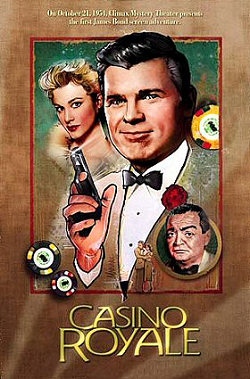
Let me begin by addressing the elephant in the room. This is not the James Bond most people are familiar with. This near-forgotten piece of media is an episode of the CBS anthology TV show Climax!, which adapted Ian Fleming’s debut novel. After its airing, the negatives were thought lost until a movie collector found a print of the episode in the early 1980s. The print was screened in cinemas a few times which is why I’m including it in this retrospective of Bond’s cinematic adventures.
The main irony at play here is that, at this point, the episode is only of interest to those already familiar with James Bond from the later successful film franchise. But the elements that made that series of films such a success are noticeably absent here. The cool mannerisms, the exotic locations, the thrilling action sequences, you’ll find none of that here. This is not to say that the episode is entirely without merit. But you really have to set it apart from what would come later and analyse it on its own. It’s not its fault that it doesn’t have what the film series has. The films were eight years away when this episode aired, and even the book series was in its infancy at the time. As a result, this episode comes across more like what it is, an episode of American television from the mid-1950s. I found it reminds me more of American films of the time than of anything people would associate with James Bond.
The story opens with Bond arriving at the Casino Royale and somebody firing bullets at him before he even has a chance to walk into the place. So, you gotta give the episode kudos for hitting the ground running. Unfortunately, the opening is followed by a scene that I don’t think works very well. Bond makes contact with his British counterpart, Clarence Leiter, who joins him at a table for a drink. When the waiter or someone else is nearby, the two discuss the rules of baccarat. When no one is around, they discuss Bond’s mission to beat the villain Le Chiffre at cards. They go back and forth between the two subjects, which makes it hard to follow. The scene exists mostly to bring the viewer up to speed and does a poor job of it. Were it not for the fact that I read the novel on which this is all based, I’d have trouble figuring out what the stakes are here.
I also have to question the need to do the briefing in the bar anyway. Bond was shot at five minutes ago, meaning Le Chiffre already knows who he is and why he’s here. If the whole charade was to conceal Leiter’s involvement in the operation, he and Bond could hav simply done the briefing in one of their hotel rooms.
This is as good a place as any to address the fact that, in this case, Bond is an American secret agent and Leiter the British one. As to why Leiter’s first name was changed from “Felix” to “Clarence”, apparently, someone involved in the production decided that the latter sounded more British. The swapping of nationalities doesn’t take away much from the story. While the Bond of the later movies is quintessentially British, the one in this story doesn’t have enough traits to be hurt or enhanced by a specific nationality. He was made an American to appeal to an American audience, no more, no less.
After the briefing, we get to know Le Chiffre himself, played by screen legend Peter Lorre. He plays the villain as a calm thinker, a planner who always knows what the odds are. While no one in the cast does a particularly bad job, I think Lorre gives the best performance here. The emotionless detachment he gives Le Chiffre is a good choice for what was destined to become the first in a long series of Bond villains. Lorre is often remembered for playing more snivelling characters in films such as M, The Maltese Falcon or Casablanca. But here, he’s generally calm and in control. The teleplay has him explain his reasoning to his underlings at some key moments and it’s a good way to show off Le Chiffre’s intellect.
The story then introduces Valerie Mathis, a mysterious woman from Bond’s past who seems to be working for Le Chiffre now, though the reason why isn’t made clear. The character is later revealed to be an agent of France’s Deuxième Bureau placed in Le Chiffre’s operation, but that’s about all we get for her backstory. Le Chiffre sends her to Bond to get some information prior to their card game. But everyone’s motivations get a little muddled here. I wasn’t sure if Le Chiffre trusted Mathis or not, nor, for that matter, if Bond trusted her either. It’s unfortunate that the episode only lasts 52 minutes as this section of the story could have used more fleshing out.
The next sequence is the card game, where Le Chiffre acts as the bank for the night and Bond tries to take his money. The game plays out as a series of rounds with ever-increasing stakes, quickly growing so large that no other players participate. This is more or less faithful to the source novel but is not particularly exciting. A player in baccarat can choose to play the two cards they’ve been dealt or ask for another card to try to improve their hand. Bond never calls for another card. He plays the cards he’s been dealt, he loses, he plays another hand, loses again, etc. It’s only after Valerie provides him with a last infusion of funds that Bond is finally dealt a hand that beats Le Chiffre’s. But it really doesn’t look like Bond used any skill here. He just kept betting until Le Chiffre’s luck ran out.
With Bond victorious and Le Chiffre cleaned out, we move into the final act. Valerie disappears and both Bond and Leiter do their best to track her down. Bond gets threatened in the casino by a henchman with a gun disguised as a cane (the first Bond gadget ever) but nothing much comes of it. After Bond returns to his room and hides his cheque behind the numberplate of his room’s door, Le Chiffre and his remaining two goons show up with Valerie and try to get Bond to tell him where the cheque is stashed. If you’re familiar with the book or its 2006 film adaptation, you might remember that Bond gets his testicles beaten at this point in the story. TV audiences in 1954 weren’t going to watch such a thing, so Le Chiffre’s henchman takes a pair of plyers to Bond’s feet instead. We don’t see what he does, but Barry Nelson, playing Bond, does a very good job at selling the spy’s agony during and after this torture.
It is here that the episode diverges from the book’s plot, and I think it’s all the better for it. In the book, Le Chiffre’s employers have sent an assassin to eliminate him, and the villain is shot dead. The assassin, having no orders to kill Bond, leaves him there. But in this TV episode, Valerie provides a clue to the villains that sends them all out of the room. Remembering a detail from his earlier briefing that Le Chiffre carries a razor blade in his cigarette case, Bond manages to get to the discarded case and uses the blade to cut his bonds and free himself instead. He then manages to dispatch the henchmen and confront Le Chiffre at gunpoint. Le Chiffre hides behind Valerie and almost escapes before Bond manages to shoot him. In the book and subsequent adaptations, the story goes on from there. But since this version ends with Le Chiffre’s passing, having Bond more involved in his death is a much better ending.
As I said before, the episode isn’t all that bad when you take it on its own. There are some instances where the pacing is a little strange to a modern audience. The episode was performed live in front of an audience in California and the recording later broadcast. This leads to some moments when the actors are crossing the stage and nothing else is happening. A more modern show would have edited those moments out. What’s really missing is a sense of international intrigue. The Casino Royale is supposed to be in Monte Carlo but if you’d have told me it’s in London, or Las Vegas, or even on the Moon, I’d believe you. You really don’t get a sense of where this is all supposed to be going on.
The same lack of specificality can unfortunately be applied to Bond himself. Barry Nelson does what he can with the material he’s given, but the short runtime of the piece does him no favours here. We really don’t get a sense of who Bond is in this story besides “generic hero”. I found Le Chiffre to be a better-defined character than Bond was. Now granted, the subsequent Bond actors had a bigger canvas on which to paint the picture of who Bond is. But this teleplay is all plot and no character. You could take Bond out and replace him with Derek Flint, Matt Helm or any of the characters who popped up in the wake of Bond’s later success, and you’d get the exact same story.
Final grade:

It’s not a bad way to spend 52 minutes, especially if you watch it for free on YouTube. But there’s very little to recommend it to Bond fans, who are about the only ones who might be interested in watching it.
 Dr. Gorgo's Den
Leave a comment